


Apple Intelligence now consumes twice as much memory as at the beginning
Apple's in-house AI model for Macs, iPhones and iPads runs locally in their device memory. And needs more and more of it.
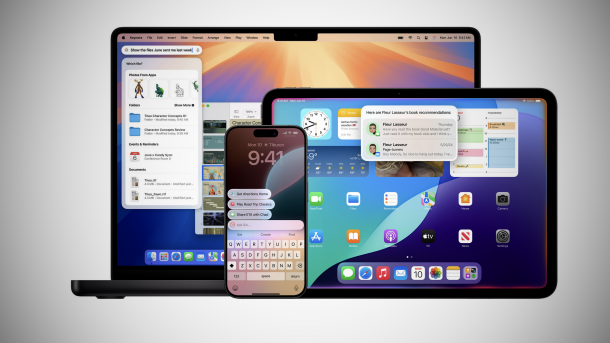
(Image: Apple)
Apple Intelligence is taking up more and more storage space on users' devices: while the manufacturer's in-house AI initially took up 4 GB on Macs, iPhones and iPads, it now takes up a whopping 7 GB. It was clear that the memory required for the AI model would increase over time. Nevertheless, the speed at which this is happening is astonishing.
The AI package will not be launched in Germany and other EU countries until April 2025, when it will probably also be available in German. With a workaround, Apple Intelligence can be activated on iPhones in Germany and used in English. The high memory requirement is due to the strategy of operating the AI model on the local device memory instead of in a cloud. Apple touts this as an advantage in terms of privacy and independence.
Almost twice as much memory required
With the release of iOS 18.2, the storage space required for Apple Intelligence increased significantly: according to the manufacturer, 7 GB, almost twice as much as before, is now required for Apple Intelligence – on every device on which the application is to be used. Unfortunately, there is no workaround for users with little available memory – It is not possible to reduce the memory requirement, for example by switching off individual functions.
With the higher requirements also came new functions. With the new "Image Playground" app, Apple makes it possible to generate comic-style images using portraits and photos from your own media library. Users can also create any new emojis on iPhones and iPads using the text prompt – Apple calls them "Genmojis". The function will be available on Macs later.
Videos by heise
So far, most of the improvements to Siri promised as part of Apple Intelligence are still missing. These are also likely to increase the memory required for the AI model. Among other things, the voice assistant system will be able to gain a deeper insight into app data and thus the user's personal context, merge the information and control app functions by voice command, for example. So far, the implementation is mainly expected in iOS 18.4, although the first components may appear earlier. A completely new Siri system based on voice models does not appear to follow until iOS 19 in the summer.


(nen)


