

BMW Panoramic iDrive: all a projection
BMW presents the Panoramic iDrive infotainment system for the New Class at the CES in Las Vegas. It is designed to revolutionize operation.
(Image: BMW)
- Dirk Kunde
BMW has also been preparing the introduction of the New Class in the media for some time. It combines a platform for electric cars with a voltage level of 800 volts and the new Panoramic iDrive display and operating system, which is set to be as revolutionary as the first iDrive system in 2001. The New Class from BMW is not a separate model category, but a technical platform based on the concept of a Software Defined Vehicle (SDV). It will be launched at the end of the year with the iX3 SUV.

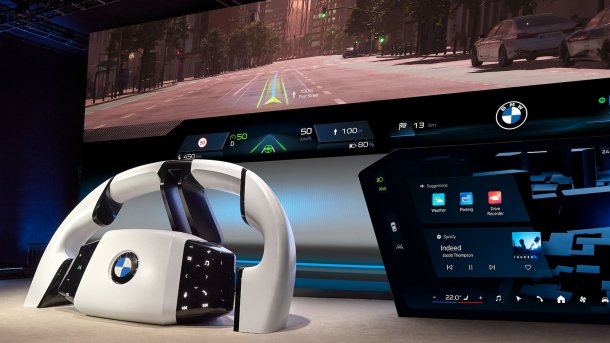
The core element of the Panoramic iDrive is the projection of all essential information. The driver sees navigation displays floating in front of him on the road via a 3D head-up display. The navigation elements, other recognized vehicles and active assistance functions create a three-dimensional impression.
Panoramic Vision
The current speed, maximum permitted speed, remaining range and battery capacity as a percentage are projected onto the lower part of the windshield. The information is projected onto an area of the windshield with a black background. This means that the information can be seen in all lighting conditions. To the right of the driver information, there are six further areas that are clearly visible to all occupants. This means that the projection extends from the A-pillar to the opposite A-pillar.
Drivers can fill these six areas with content of their choice. The calculated arrival time or the outside temperature, the current music track or the remaining range then appear. BMW divides the available information into MyLife, MyCar and MyJourney. If this is too distracting for you, you can also leave the six projection surfaces blank. The content is selected on the screen and then dragged upwards to the desired location using your finger. BMW offers additional third-party apps for video and audio streaming, games and productivity on the screen via the Faurecia Aptoide app store.
Screen leans towards the driver
The touch-sensitive screen offers further personalization. There is space for widgets on the left-hand side. A photo can be selected as the screen background in the right-hand section, as can a desired color for content and ambient lighting. The central display with matrix backlight technology is positioned so that it can be easily reached with a finger from the driver's seat. The screen also leans towards the driver. The sides are tilted 72.5 degrees towards the steering wheel. This means that the edges of the screen form a line with the projections of the 3D head-up display.
BMW Panoramic iDrive (5 Bilder)

BMW
)Three control options
BMW has three control options in the New Class: Control buttons on the steering wheel, the touch-sensitive screen and a voice assistant. With "iDrive", BMW adopts the name of its menu control system, which premiered in 2001 in the form of a rotary wheel. Two years later, the first head-up display appeared in a BMW 5 Series. When developing the operating logic, BMW incorporates feedback from around 3000 customers in its usability labs on different continents. "From the first production model of the New Class at the end of this year, the new BMW Panoramic iDrive will be an integral part of all future BMW models," says Frank Weber, BMW Board Member for Development.
Software version OS X
"The BMW Operating System X will not only make our vehicles more intelligent and user-friendly, it will also enable much more personalization and make every new BMW your very own," announces Adrian van Hooydonk, Head of BMW Design. The software behind the display and operating concept is a proprietary development. BMW calls it OS X. It is the tenth version of the operating system based on the Android Open Source Project. "The BMW Panoramic iDrive with Operating System X demonstrates the potential of a software-defined vehicle. It offers intuitive operation, emotional driving experiences and individual personalization," says Stephan Durach, Head of UI/UX Development at BMW.
Videos by heise
Steering wheel shows active assistants
Another control element for the vehicle is the steering wheel. Elements for activating the driving assistants are located on the left-hand side. On the right-hand side, content such as media playback and telephone calls can be controlled. The control panels have a relief-like surface and provide haptic feedback when pressed. This allows the desired function to be activated without having to look at the steering wheel. The control panels are also illuminated. The driver assistance systems light up white when they can be activated and green when they are activated. Behind the steering wheel there are two levers for lights, windscreen wipers and indicators.
Big eyes
BMW visualizes its voice assistant. When activated, a head with large, glowing eyes appears, although they have no pupils. BMW has not given the assistant a name. The designers are convinced that the eyes are the only way to depict emotional reactions to user input. An AI language model (Large Language Model) works in the background.
(ds)