


Collective agreement at VW: 35,000 jobs to be cut in socially responsible manner
After marathon negotiations, VW and employee representatives have agreed on a new collective wage agreement. 35,000 jobs will be lost, but without redundancies.
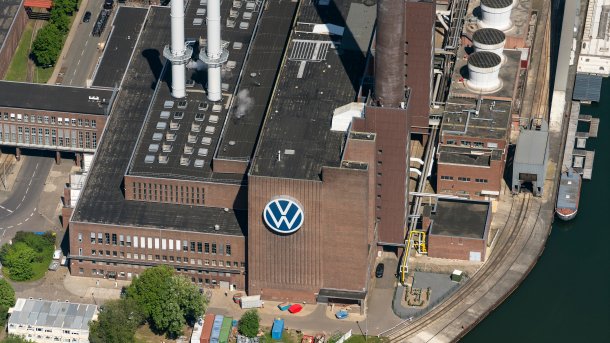
The e-Golf is to be built in Wolfsburg in the future.
(Image: Aerovista Luchtfotografie/Shutterstock.com)
After long negotiations this week, the VW Group and the IG Metall trade union agreed on a new collective wage agreement on Friday. While the new collective agreement rules out compulsory redundancies and the threatened closure of plants, around 35,000 jobs are to be lost in the Group over the coming years.
"We had set ourselves the goal of no plant closures, no compulsory redundancies and no cuts in monthly pay," said Thorsten Gröger, District Manager of IG Metall Lower Saxony and Saxony-Anhalt, in Hanover on Friday evening. "We are pleased that we have put together a package in which none of these red lines are crossed."
35,000 fewer jobs
According to Gröger, the new collective agreement runs until the end of 2030, during which time compulsory redundancies are ruled out. If no follow-up agreement is found, VW has committed to providing a total of one billion euros for the workforce in the first half of 2031, according to the union – However, details of the exact structure remain open.
Nevertheless, 35,000 jobs are to be lost in the Group by then. The job cuts are to be "socially responsible". This could be achieved through age-related retirement or other instruments, said the IG Metall official.
The wage increase of 5.5 percent per year will be maintained until 2030, but will no longer be paid out. It is to flow into "personnel instruments" for socially responsible restructuring, but these still need to be developed.
"We find ourselves in a situation in which the political framework, particularly for electromobility, has caused uncertainty in the market," said Gröger. "The whole thing is taking place in an environment in which the entire industry in Germany is under considerable pressure."
"No sites will be closed, no one will be made redundant and our in-house wage agreement will be secured for the long term," said Daniela Cavallo, Chairwoman of the General Works Council of Volkswagen AG. "With this triad, we have achieved a rock-solid solution under the most difficult economic conditions."
Production capacity at the German VW plants is to be reduced by over 700,000 vehicles. However, this is not to be achieved through plant closures, but through a "solidarity-based" distribution of production across the various locations. For example, production of the SSP electric platform will in future also take place at the main plant in Wolfsburg, which will be converted for this purpose. At the same time, production of the combustion-powered Golf will end in Wolfsburg and is to be relocated to Mexico. The Wolfsburg plant will be scaffolded in stages from 2029 for the production of the next electrified Golf model.
Videos by heise
Dresden and Osnabrück: future open
Vehicle production in Dresden ("Gläserne Manufaktur") will end at the end of 2025, where the ID.3 was previously assembled. "An alternative overall concept is now being developed for the period from 2026," announced IG Metall. "Volkswagen AG will continue to be present at the site with its own activities in the future." In what form is still completely open
The future of the plant in Osnabrück is also open. Production of the T-Roc Cabrio is to be extended there until "late summer 2027". "This also gives us time to develop a future perspective for the employees," said Cavallo. According to information from the Bild newspaper, negotiations are also underway regarding the sale of the site, with a defence company being interested.


(vbr)


