


Digital coupling: 8.25 million euros for modernization of freight train services
The digital automatic coupling is set to replace 100-year-old technology. However, not everyone thinks its widespread introduction makes sense.
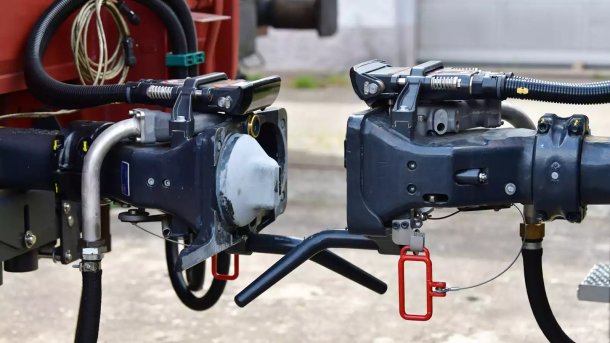
The Digital Automatic Coupling is designed to make rail freight transport more efficient.
(Image: DB)
The introduction of the Digital Automatic Coupling (DAC) in rail freight transport is moving closer with the release of additional federal funding. Deutsche Bahn has announced that the Federal Ministry for Digital and Transport Affairs (BMDV) has released an additional 8.25 million euros for the DAC4EU project. From 2026, up to 100 pioneering trains with the modern coupler will be running in Europe. However, not everyone involved is entirely positive about the project.
At first glance, the switch to the new coupler seems logical or even overdue. After all, the DAK replaces the 100-year-old screw coupling. This not only has to be done by hand and is therefore dangerous: it is also considered to be prone to faults, increases costs and slows down the assembly of trains. The new process should also enable digital monitoring of train completeness for the first time, as a continuous power and data connection is established.
Criticism: not so important for block trains
From 2028, 500,000 freight wagons in Europe are to be equipped with the DAK. Several European railroads are working together on the project. Practical tests with prototypes were already carried out at the beginning of 2022. The DAK automatically connects freight wagons with each other. It establishes a mechanical and electrical connection between the wagons without manual work by the shunting staff, and automatically connects the compressed air line for the brakes. In addition, the electronic control of the brakes should shorten the braking distance and thus allow faster journeys.
Videos by heise
But there are also skeptical voices: The European Rail Freight Association (ERFA) is critical of the planned nationwide introduction, explained ERFA President Dirk Stahl in an interview with Deutsche Verkehrs-Zeitung. The association argues that digital coupling will mainly benefit single wagon load traffic. In intermodal and block train traffic, which mostly originates from the container ports, many of the advantages of the DAK would not come into play. And in the case of multi-system locomotives, there are even technical concerns due to the additional weight of the hybrid couplings of around 1.5 tons. According to the association, it would be more important for the European Union to focus on the European standards for rail control, ERTMS (European Rail Traffic Management System) and ETCS (European Train Control System).


(mki)


