


Electrical signals from mushrooms control robots
Fungi can be used as sensors for controlling biohybrid robots. To do this, the signals of the fungal mycelia must be decoded.
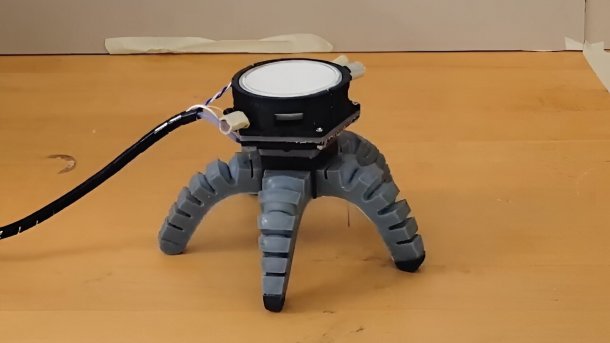
The biohybrid starfish robot is stimulated to walk by light. Fungi serve as sensors.
(Image: Cornell University)
Researchers at Cornell University have built two biohybrid robots that use the electrical signals of royal oyster mushrooms in response to their environment to control the robots. The scientists believe that this method enables robots to respond to their environment better than synthetic sensors can.
Living organisms can react to environmental stimuli faster and more flexibly than artificial sensors. The interdisciplinary scientists at Cornell University took advantage of this to use royal oyster mushrooms as a type of environmental sensor for robots. They describe the method in the study "Sensorimotor control of robots mediated by electrophysiological measurements of fungal mycelia", which has been published in Science Robotics.
The scientists used the electrical signals of fungal mycelia, the underground vegetative part of fungi. The fungi react to environmental stimuli by emitting electrical signals that are transmitted to the neuron-like ion channels of the mycelial membrane. The scientists pick up these signals with electrodes on which they have previously placed a fungal culture. The mycelia thus establish a permanent connection with the electrodes.
Videos by heise
The scientists removed noise and electromagnetic interference from the signals recorded by the electrodes in order to obtain a clean signal from the fungi. This enabled them to record and process the electrophysiological activities of the mycelia in real time. A controller inspired by central pattern generators monitors the raw electrical signals, detects the rhythmic signal peaks and converts them into a digital control signal. This is used to control the robots' actuators.
Walking and rolling using control signals from mushrooms
The researchers used two different robots for their experiments: a soft, starfish-shaped robot with five legs and a simple four-wheeled rolling robot. In both, they installed the mushrooms cultivated on electrodes in a 3D printed scaffold. In a first experiment, they made the robots react to the natural, continuous signal peaks of the mycelia by making the machines move and roll via their actuators. In the second experiment, the researchers specifically stimulated the fungi with ultraviolet light in order to influence the robots' locomotion. In a third experiment, the researchers succeeded in completely eliminating the continuous signal from the mycelia.
According to the scientists, their research results show two things: in principle, it is possible to control a robot with biological organisms. Much more important, however, is the realization that it is possible to "establish a real connection to a living system". To do this, however, the electrical signal of the organism must first be decoded in order to be able to record and use it without interference.

The scientists see further potential applications for the system. So far, they have only used light, to which the fungi reacted. In the future, this could also include chemicals. For example, the technology could enable robots to detect the soil chemistry in row crops and regulate the supply of fertilizer accordingly.


(olb)

