


Photo news: Instax-Lomo and paid firmware from Pentax
Lomography promises the best instant camera in the world, Pentax sells software for gray filters in the camera and the R5 II represents modernity.
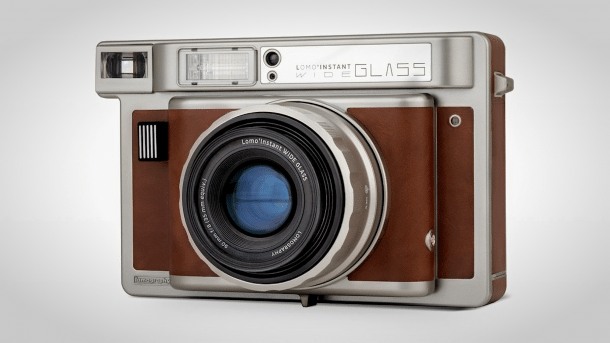
The Lomo'Instant Wide Glass with, well, glass lens.
(Image: Lomography)
The big new camera launches are probably already behind us in 2024, and Black Friday with its bargains on standard products is still a few weeks away – so some smaller manufacturers are using this fall to launch their new products. Ideal for our column. Let's start with Lomography.
Anyone who immediately thinks of the blurred avant-garde statements of the 1990s, shot from the hip, is not entirely wrong. Initially importing cheap Russian cameras, which were then sold at a hipster mark-up, Viennese students invented "lomography". This became the company that still offers analog cameras for older film formats today. But now it is the turn of the"Lomo'Instant Wide Glass", the modern Instax Wide film for instant photos.
According to the website, the result is nothing less than the "best instant camera in the world". Lomography attributes this primarily to the glass lens with an equivalent focal length of 90 millimetres. Most new instant cameras available to buy now have plastic lenses. The manufacturer also promises "razor-sharp images" and "bright, true-to-life colors".
Instant photo remains instant photo
This may be true for the Instax Wide film, but even the sample images from Lomography are still dull, lacking in color and not really sharp. Just what typical instant pictures offer today. It may be debatable whether the large Polaroid films from the 1970s and 1980s were better, but today's cameras for Instax films are certainly more compact than even a late SX-70. And even just as a toy, the new Lomo is not too expensive at 279 euros. The predecessor, without the glass lens, was available for 199 euros.
Apart from the instant photo look, the new camera also has a close focusing distance of 30 centimeters, flash, zone focus and the splitzer attachment for multiple exposures. As a special gag, there is a wireless remote shutter release built into the lens cap. If you are already thinking about a Christmas present, please don't forget: Depending on the offer, each picture from the Instax 10-pack costs around one euro. And these are often in short supply at the end of the year.
Videos by heise
ND filters for Pentax for money
You also have to pay extra if you want to simulate brightness gradients (Grade ND) in the camera with a Pentax from Ricoh Imaging. As previously in Japan and the USA, updates are now also available in Germany for a fee. It's clear that the typical brightness gradient for a sunset only costs a few clicks in any modern image editing program, but Pentax thinks that many people would want to do this in the camera. 80 euros are due if you want to upgrade your K-1, K-1 II, K-3 III or K-3 III Monochrome in this way. Orders can be placed via the Ricoh website.
When is Astro Assist coming to Germany?
Astrophotographers who have been working with Pentaxes for a long time will be interested to know that the company has many fans in this scene in particular, because the cameras already come with some special functions for this purpose ex works. In Japan, firmware with "Astro Assist" is also available for the equivalent of around 70 euros. This adds three new functions to the cameras, namely new focusing via remote control, editing with astro presets in the camera and "Star AF". This allows you to focus on stars without changing the image section. This is particularly practical on a tripod, as well as when refocusing without touching the camera. It seems that Ricoh is planning to offer these so-called "premium features" in Germany soon, but this is not yet the case.
Canon R5 II in practice
Our test of Canon's EOS R5 Mark II is finally complete. Our colleague Peter Nonhoff-Arps always thinks back to his first R5 and describes how he achieved a higher yield of good pictures with pre-shooting, eye control for the autofocus and the other new features. Canon has hardly improved the search in the menus, but the image quality and processing are convincing. And how the system called "Eye Control" by Canon works – Keyword Purkinje images – is also explained. This test is therefore also our recommendation for a long read, even if not quite in time for the weekend.


(nie)


