


Report: Chinese companies order more H20 chips from Nvidia for DeepSeek
Alibaba, ByteDance, Tencent & Co. will likely order far more AI chips from Nvidia than before. This is likely due to the integration of AI models from DeepSeek.
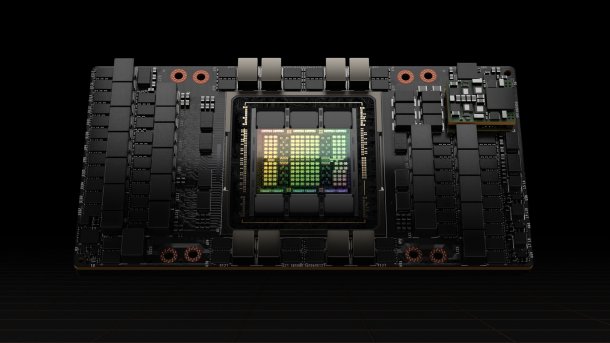
Not for China: Nvidia's AI accelerator H100.
(Image: Nvidia)
The significant increase in demand for the comparatively inexpensive AI models from Chinese start-up DeepSeek since the beginning of this year is apparently having a positive effect on Nvidia. It is now being reported that the market leader for AI accelerators has recently recorded significantly more orders from China. According to the report, Chinese companies require new H20 chips, the most powerful AI accelerators to date that Nvidia is allowed to export to China, in order to integrate DeepSeek models into their products and services.
Since 2022, Nvidia and Co. have only been allowed to sell lame GPU accelerators to China. After Nvidia initially used a loophole to be able to export stripped-down versions of its AI accelerators there, the US government at the time also banned these AI accelerators, known as A800 and H800, for China in 2023. The H20 chip is based on the same architecture (Hopper), but is specially adapted to the US export restrictions.
H20 not only in demand from large Chinese corporations
Initially, Chinese companies spurned Nvidia's export chips, but since the rise of DeepSeek, the tide has apparently turned. Reuters is now reporting, citing insiders, that Chinese companies such as Tencent, Alibaba and ByteDance have significantly increased their orders for the H20. The AI chips will be used for their own products, where DeepSeek will be integrated, but the AI models will also be made available to other companies in China via cloud services.
Videos by heise
At the same time, however, a source at a major server manufacturer in China says that even smaller companies in sectors such as healthcare and education are buying AI servers equipped with Nvidia's H20 and DeepSeek models. Previously, it was almost exclusively larger financial and telecommunications companies that purchased such servers for artificial intelligence (AI).
H20 demand also due to new US export restrictions?
However, the news agency also writes that the new US government under Donald Trump could also restrict H20 exports to China. Stricter export restrictions have already been discussed internally. Corresponding preliminary considerations had already begun during the previous Biden administration. The export restrictions are intended to prevent powerful AI accelerators from being used to arm the Chinese military. Alongside DeepSeek, this could be another reason for the recent increase in H20 demand.

The Chinese companies Tencent, ByteDance and Alibaba did not comment on the report when asked, but had previously announced plans to integrate AI models from DeepSeek. Tencent, for example, is planning to integrate the technology into the WeChat app, which is almost indispensable in China and is used not only for messaging but also for payment transactions. Chinese car manufacturer Great Wall Motor (GWM) has already integrated DeepSeek models into its networked vehicle system.
One million H20 chips estimated for 2024
Market observers estimate that Nvidia shipped around one million H20 chips last year, which would have generated more than 12 billion US dollars in revenue. That would be significantly more than was reported at the end of 2024. According to the study, Microsoft buys the most Nvidia accelerators, followed by ByteDance and Tencent. However, according to the study, the Chinese companies together purchased less than half a million AI chips. Alibaba was not mentioned.
When asked, Nvidia did not want to provide any figures on exports to China and only explained that its own products had prevailed "due to their performance in a highly competitive environment". The graphics chip manufacturer will present new business figures today. The impact on turnover should then become clear.


(fds)

