


Boston Dynamics' humanoid robot Atlas works autonomously
Robot Atlas is being prepared for work by Boston Dynamics. It autonomously sorts car parts into shelves.
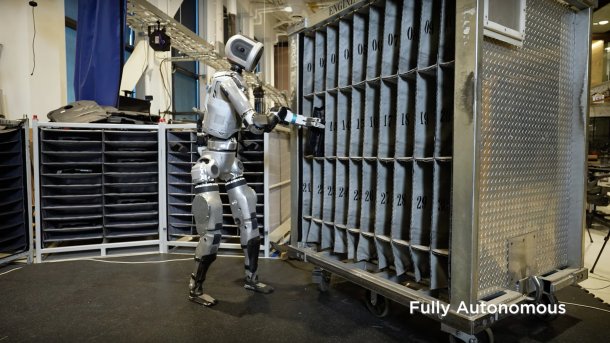
The humanoid robot Atlas sorts car parts independently.
(Image: Boston Dynamics (Screenshot))
The robotics company Boston Dynamics is continuing to prepare its electric humanoid robot Atlas for the world of work. After the company has allowed the robot to demonstrate its "sporting" and movement skills, it is now obviously time for the fun to end and it has to carry out its first tasks. In a video released on Thursday, Boston Dynamics shows how Atlas autonomously sorts car parts in real time under laboratory conditions.
The video shows how the humanoid robot removes car parts from a shelf with horizontal compartments and sorts them into another shelf with narrow vertical compartments. Sometimes it even has to squat down to pick up a part.
Videos by heise
The challenge here is that Atlas first has to pull a car part slightly out of the compartment of a shelf in order to be able to pick it up safely for transportation. The robot then turns to another shelf to place the car parts upright in a narrow compartment. The whole process works completely autonomously and in real time, as Boston Dynamics emphasizes. Atlas was therefore not remote-controlled. This places high demands on object recognition and movement adaptation by training the underlying artificial intelligence (AI).
Autonomous reaction to disturbances
"The robot is able to recognize changes in the environment (e.g. moving devices) and handling errors (e.g. failure to insert the cover, stumbling, collision with the environment) and react to them by using a combination of vision, force and proprioceptive sensors," says Boston Dynamics.
Empfohlener redaktioneller Inhalt
Mit Ihrer Zustimmung wird hier ein externes YouTube-Video (Google Ireland Limited) geladen.
Ich bin damit einverstanden, dass mir externe Inhalte angezeigt werden. Damit können personenbezogene Daten an Drittplattformen (Google Ireland Limited) übermittelt werden. Mehr dazu in unserer Datenschutzerklärung.
In one sequence of the video, for example, you can see that this already works quite well. For example, Atlas does not hit the shelf compartment correctly when inserting it, "thinks" briefly and then inserts the item into another compartment on its own. The corrections are made completely autonomously by the robot itself.
It is unclear whether this autonomous action is the first result of the recent cooperation between Boston Dynamics and Toyota's research department. Toyota has contributed research results on object recognition and the training of large language models (LLMs) in order to develop multitasking, image processing and speech-conditioned basic models for skillful manipulation.
This should also lead to an improvement in whole-body skills. Here you can see possible first results in the video. Instead of Atlas simply turning around completely to the next shelf, the robot uses its 360-degree rotating waist. This minimizes movements and saves time.
Possible use in the automotive industry
The fact that Boston Dynamics is apparently training its humanoid robot for use in automotive production is no coincidence. The Hyundai Group, which also manufactures cars, bought Boston Dynamics. The cooperation with Toyota, the world's largest car manufacturer, may also have helped to initially prepare the robot for use in car factories. Both companies could want to use Atlas in this area, which already has a high degree of automation through robots.



(olb)

