


Microsoft tries its hand at data centers made of wood
Microsoft is building two atypical data centers. A large part is made of cross-laminated timber to reduce the carbon footprint.
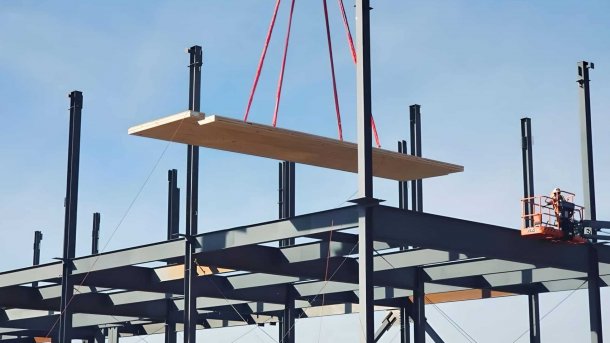
The floor insert of a new Microsoft data center made of wood.
(Image: Microsoft)
Due to the boom in artificial intelligence, hyperscalers are building many new data centers with dozens to hundreds of thousands of computing accelerators. To reduce the impact on the environment during construction, Microsoft is now testing an atypical construction method with a high proportion of wood.
So-called cross-laminated timber (CLT), best translated as cross-laminated timber, is partially replacing concrete and steel. The latter two building materials are harmful to the climate due to the high temperatures required during production, which are well above 1000 °C. In the case of concrete, the limestone cement it contains also releases CO₂ during the manufacturing process.
CLT is designed to ensure high stability with several layers of solid wood glued together. Microsoft can still cast the foundation from concrete. Vertical steel struts and steel grids on each additional level provide additional support. Wooden panels form the floors and some of the walls.
Empfohlener redaktioneller Inhalt
Mit Ihrer Zustimmung wird hier ein externes YouTube-Video (Google Ireland Limited) geladen.
Ich bin damit einverstanden, dass mir externe Inhalte angezeigt werden. Damit können personenbezogene Daten an Drittplattformen (Google Ireland Limited) übermittelt werden. Mehr dazu in unserer Datenschutzerklärung.
35 to 65 percent CO₂ savings
In a blog post, Microsoft writes that this construction method should save around 35% CO₂ emissions compared to traditional steel structures. Compared to precast concrete elements, it is said to be 65 percent. The company does not provide any absolute figures.
Microsoft is currently building two data centers with cross-laminated timber in the US state of Virginia to test the principle. If the process proves successful, more could follow.

Microsoft wants to be net CO₂-neutral by 2030. However, since the target was set in 2020, the company's greenhouse gas emissions have risen by 40 percent – to between 15.4 million and 17.2 million tons of CO₂ equivalents, depending on the calculation. The construction of new data centers is a major factor.
Empfohlener redaktioneller Inhalt
Mit Ihrer Zustimmung wird hier ein externer Preisvergleich (heise Preisvergleich) geladen.
Ich bin damit einverstanden, dass mir externe Inhalte angezeigt werden. Damit können personenbezogene Daten an Drittplattformen (heise Preisvergleich) übermittelt werden. Mehr dazu in unserer Datenschutzerklärung.


(mma)

