


Harmonic Drive: How a wobbling gearbox ensures precise robot movements
Robot actuators must generate high torques, but at the same time be light and compact. The ideal application for the Harmonic Drive wobbling gearbox.
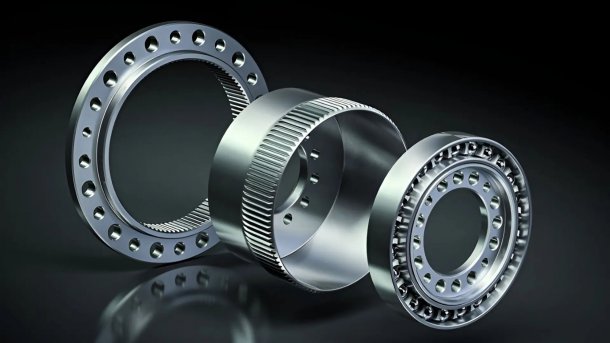
The Harmonic Drive wobbling gearbox consists of just three main components: Circular Spline, Flexspline and Wave Generator (from left to right).
(Image: Harmonic Drive SE)
The electric humanoid robot Atlas and the robot dog Spot from Boston Dynamics, the surgical robot Da Vinci and NASA's Curiosity and Perseverance robots use the wobbling Harmonic Drive gearbox to achieve the most precise movements possible with high torque using electric actuators. And industrial robots, such as those from Fanuc, Kuka and Universal Robots, can hardly be imagined without harmonic drives. But what does the gearbox that causes the desired wobbling motion consist of? And how does it work?
The beginnings of the harmonic drive date back several decades. It was developed in 1955 by the American inventor C. Walton Musser. He was very creative and held several patents, for example for power steering systems, recoilless rifles and pneumatic inflation devices for life jackets, as well as for various developments that were used in ejection seats for military jet-propelled aircraft.
Structure
The first harmonic drives were first used commercially in the early 1960s. It is a gearbox that consists of only three main components: a wave generator, a flexible spline and a circular spline.
The wave generator is slightly elliptical and has a ball bearing ring on the outer edge. It serves as the input hub for the drive. The Flexspline is cup-shaped, flexible and has external teeth. However, it only deforms radially, but otherwise remains torsionally rigid. The circular spline is essentially a rigid ring with internal teeth. The number of its internal teeth is two higher than the number of external teeth on the flexspline. All three components are pushed into each other to form the harmonic drive.
How it works
As soon as the Wave Generator rotates, the flexible ellipse generates a wobbling motion within one revolution, which is transmitted to the flexible Flexspline. As a result, only 30 percent of the outer teeth of the Flexspline are in contact with the inner teeth of the Circular Spline at any given time.
Empfohlener redaktioneller Inhalt
Mit Ihrer Zustimmung wird hier ein externes YouTube-Video (Google Ireland Limited) geladen.
Ich bin damit einverstanden, dass mir externe Inhalte angezeigt werden. Damit können personenbezogene Daten an Drittplattformen (Google Ireland Limited) übermittelt werden. Mehr dazu in unserer Datenschutzerklärung.
The circular spline is usually firmly connected to a housing. Due to the continuous shaft movement, the Flexspline rotates within the circular spline, the rotation of which runs in the opposite direction to the drive.
Precise robot movements in the smallest of spaces
Thanks to a high number of teeth, very large reduction ratios can be achieved with the Harmonic Drive and thus also high torques, which are an advantage for robot actuators. In addition, a different number of teeth makes it very easy to realize different reduction ratios for all conceivable application scenarios.
Videos by heise
In addition, such a gearbox is very light and compact due to its few components, which also favors its use in robot actuators. The gearbox is also virtually maintenance-free and durable. This results in the reliability required for robot technology.
However, there is another decisive factor for use in robots: the gearbox operates backlash-free, as there is no play between the teeth and the internal gearing. This allows very finely tuned and therefore precise motion processes to be implemented via an electric motor. Accordingly, the harmonic drive is used in electric robot actuators to enable even the smallest movements to be reproduced with high precision, high torque and in the smallest of spaces.



(olb)

