


Fiber optic expansion: Tough battle for customers
Dangerous dual expansion or infrastructure competition? How Deutsche Telekom and its competitors are wrestling with each other – and politicians are watching.
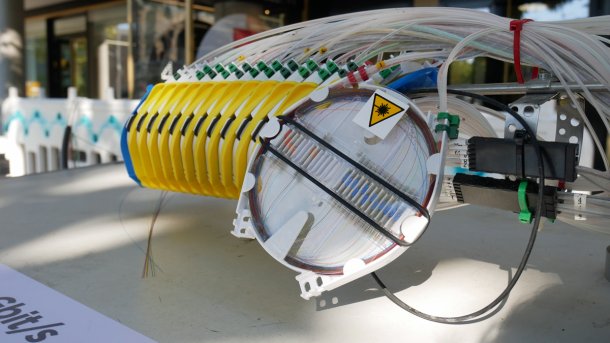
Fiber optics for a home connection in Berlin.
(Image: heise online/vbr)
The expansion of fiber optics in Germany is progressing. Roads are being torn up all over Germany and fiber optic cables are being sunk into the ground. The days of copper wire and coaxial cables seem to be numbered. But the industry is warning that expansion is at risk of being slowed down further. This is because, on the one hand, conditions are becoming more difficult and, on the other, the battle is being fought tooth and nail. Telekom is at the center of the accusations.
The expansion of fiber optics is politically desired. The fastest network, everywhere – that is the hope associated with it. And the state has significantly accelerated the expansion in recent years: municipal utilities, network operators and new providers founded with investor funds are laying fiber optic infrastructure. By 2025, around half of all households in Germany should have fiber to the building (FTTB).
In the medium term, the copper wire connection, which is still the dominant medium on the "last mile" into homes, is also set to make way for this. With technologies such as VDSL/vectoring and G.fast, the end of the line has been reached for the old local loop (local loop) from the era of the Bundespost. The copper network is under the control of Deutsche Telekom. Network operators have been calling for a shutdown strategy for the copper network for some time. Although the Federal Ministry of Digital Affairs wants to deal with this, further delays are to be feared in view of the expected new elections.
After the gold rush, the fiber optic grave looms
During the low-interest phase, institutional investors in particular were looking for reliable investment opportunities with calculable returns. There was a gold-rush atmosphere on the market, with new fiber optic companies springing up like mushrooms. According to industry experts, a house connection costs providers around 1000 euros. With consumer prices of between 30 and 100 euros per month and an assumed service life of at least 20 years, this seemed to be a safe investment opportunity, whose refinancing and expected returns were easy to calculate.
However, with the rapid rise in interest rates two years ago, this became less attractive – Investors once again had more comparably secure alternatives to fiber optic gold, such as government bonds, some of which previously had zero interest rates. In addition, fiber optic companies now also have to pay more for the debt they use to pre-finance the expansion. This is why some companies are now adapting their strategy: instead of just developing areas ("Homes Passed"), the number of "Homes Activated" is becoming important – households that are actually connected and regularly pay for a service.
Fiber optic connections are faster and more stable than copper-based connections. However, the take-up rate of customers who actually book and pay for a connection falls short of expectations. And the expansion in the houses, when the cable is pulled into the apartment, also costs money and sometimes causes enormous bureaucratic effort with housing management or owners' meetings.
During the low-interest phase, it didn't matter: first of all, companies had to "throw in the towel", as they call it in the industry. In other words, making as many households as possible accessible with fiber optic networks. The sequence: planning, announcement, marketing, expansion. A company plans the expansion, then approaches potential customers and, as soon as a certain number of connections have been sold, concrete plans are drawn up. Excavators then roll in, slits are made in roads and earth rockets dig through the ground.
Videos by heise
Sometimes an expansion is announced that then drags on for years. To show that work is continuing, progress is made in incremental steps. In some areas, the fiber optic cable is in the street, but the house is not connected. Elsewhere, construction is already underway for the house connection, but the connection to the network is missing. A problem of a lack of construction capacity, say operators. Only rarely is an expansion officially canceled – because the towel on the map is important.
This is linked to another development that is now preoccupying companies and politicians: The so-called double expansion or superstructure. While infrastructure such as electricity, water, gas or district heating is usually connected to homes once by territorial monopolists, European law stipulates that competition should prevail in the expansion of fiber optics. This brings market-based interests into play.
The problem of dual expansion
It can happen that two companies with their own infrastructure compete for customers in an expansion area. This should not really be a problem. This is because fiber optic connections, lines or data traffic can easily be shared in accordance with the "open access" principle. The network operator that has expanded leases its connections, access or a separate fiber to another provider.
However, despite all commitments to open access, problems arise time and again. Even the announcement that a second provider is expanding a fiber optic network can turn the first provider's calculations upside down. Deutsche Telekom in particular is accused of exploiting this and operating a "strategic superstructure". In other words, it deliberately goes into expansion areas or parts thereof where other providers have already started marketing or even actual development.
The Federal Network Agency should find out whether this is actually the case. A monitoring body set up specifically for this purpose collects reports from network operators, municipalities and other stakeholders. An interim report from April 2024 caused discussion. While the Federal Network Agency was still very critical of Deutsche Telekom in particular at the draft stage, the concerns were significantly reduced in the final version. The industry suspected interference from the very top.
The Berliner Tagesspiegel was able to prove that the Federal Ministry for Digital and Transport (BMDV) exerted influence via documents under the Freedom of Information Act. However, the BMDV vehemently denies that this was inadmissible: "At the time when the first draft of this interim report was available, for example, a whole series of submissions were missing, which were later made up for," explains a spokesperson. "In light of this development, these votes took place and the report was tightened up accordingly."
By the beginning of October, the monitoring body had received 482 reports. A date for a further report has not yet been set. In fact, it is likely to be difficult to prevent the double expansion completely. However, as a look at the regions affected shows, it is doubtful that the reality makes sense for everyone involved.


