


Intel: Launch of Arrow Lake was a "humiliating lesson"
In independent tests, Intel's new flagship Core Ultra 9 285K is not as fast as in the development lab – Intel wants to improve.
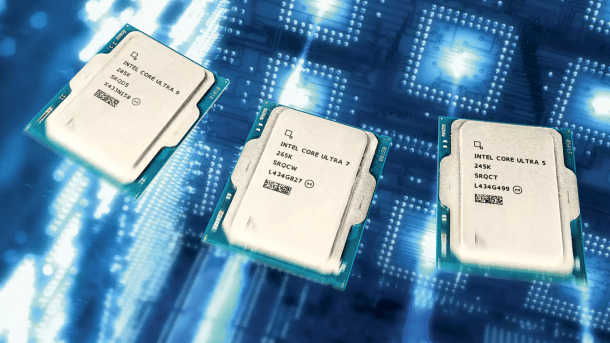
Intel's Arrow Lake Trio is not yet running as fast as the manufacturer had planned.
(Image: c't)
In an interview, an Intel manager has commented for the first time on the mixed tests of its Arrow Lake flagship Core Ultra 9 285K. The launch "didn't go as we had planned", said Director of Technical Marketing, Robert Hallock. He had only joined Intel just over a year ago, having previously held the same position at Intel.
According to Hallock, the performance of Intel's new desktop platform found in the tests is below "what we expected and what we intended," he said in a video interview with Hot Hardware (from 11:07). There had been a disconnect between what Intel itself had measured and what journalists had seen. Referring to the testers, Hallock emphasized: "This was not their fault". It was a "humiliating lesson" for Intel, said the Intel manager.
Across all media, the measurement results of Arrow Lake were mixed, including in our tests. In some well threaded applications, the 285K is the fastest desktop CPU, but it falls behind in games in particular. In some cases, it even falls behind its predecessors such as the 14900K, which, however, requires a significantly higher power consumption. It is also particularly bitter for Intel that the Ryzen 9800X3D, which appeared shortly afterwards, with its eight cores clearly outperforms the 285K with 24 cores (8P+16E cores), especially in games, and is even more economical than the latter.
Updates for BIOS and Windows still in 2024
According to Hallock, Intel has already established why this is the case. "We need to fix a few things," he said, adding that the solutions can be found in the BIOS and operating system. At the end of November or beginning of December, Intel wants to comment on this in detail, Hallock continued. Among other things, a Windows update that improves the performance of Arrow Lake should then be available. This indicates that, among other things, the assignment of threads to the cores does not yet work as Arrow Lake needs it to.
In contrast to the 13th and 14th core generation, Intel has reversed the internal behavior of the cores in the new processors. While new threads were first started on the faster and more power-hungry P-cores in the predecessors, they are first assigned to the E-cores in the Core Ultra 200S. Only when their performance is no longer sufficient are the threads moved to the P cores, which should only take a few milliseconds.
Videos by heise
Memory latencies should not be to blame
Whether the problem lies here was not asked in the interview, but Robert Hallock rejected another frequently expressed assumption. The inconsistent performance of Arrow Lake has nothing to do with RAM latencies. Intel had seen delays of up to 180 nanoseconds with a certain combination of hardware and software. However, the platform is able to work with latencies of 70 to 85 nanoseconds. Hallock did not say whether this requires the still very rare and expensive CUDIMMS with high clock rates using a separate amplifier chip on the memory module.


(nie)


