


SpaceX: Next Starship test flight successful, but booster not captured
Donald Trump himself traveled to Texas to watch the next test flight of SpaceX's Starship. Once again, it was largely a success.
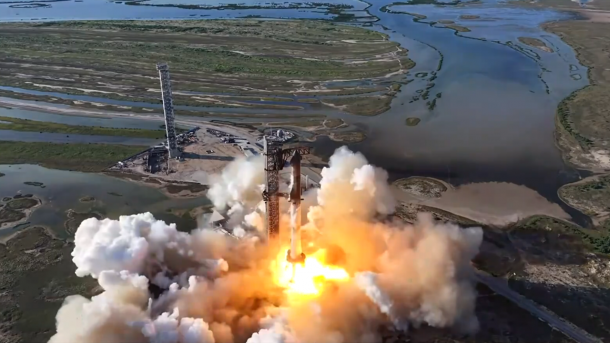
The picture book start
(Image: SpaceX)
Under the watchful eye of the next re-elected US President Donald Trump, SpaceX's giant Starship rocket completed its sixth test flight on Wednesday night almost flawlessly. Only the planned capture of the main stage did not work because automatic checks of the hardware aborted the flight back to the launch pad. SpaceX did not disclose what problems they found, but instead the booster descended gently into the Gulf of Mexico. Meanwhile, the spacecraft itself reached Earth orbit and fired one of the engines again as planned. The Starship then returned to Earth, splashed down at the designated location in the Indian Ocean and burst into flames.
Empfohlener redaktioneller Inhalt
Mit Ihrer Zustimmung wird hier ein externer Inhalt geladen.
Ich bin damit einverstanden, dass mir externe Inhalte angezeigt werden. Damit können personenbezogene Daten an Drittplattformen übermittelt werden. Mehr dazu in unserer Datenschutzerklärung.
Watch Starship's sixth flight test https://t.co/acpdO2brbP
— SpaceX (@SpaceX) November 16, 2024
Various tests in orbit
Trump had flown to Texas especially for the impressive launch of the world's largest rocket; SpaceX CEO Elon Musk has been one of the President-elect's closest confidants for months. Both were then able to watch as the rocket reached an altitude of almost 200 kilometers. On board the spaceship was a plush banana as an indicator of weightlessness and the first payload of a Starship. According to SpaceX, it was tested to the limit during the flight and was able to withstand it. It reached speeds of more than 25,000 kilometers per hour.
Videos by heise
The Starship consists of the Super Heavy booster, which is around 70 meters long, and the upper stage, which is around 50 meters long. The spaceship and rocket are to be reusable after returning to Earth and will be able to take astronauts to the moon for NASA in the future. However, SpaceX hopes to reach Mars one day. In April 2023, a complete Starship took off for the first time, but only remained intact for a few minutes. On November 18, 2023, the second launch attempt was successful before the rocket exploded. The third test flight succeeded in mid-March 2024 and lasted significantly longer, with the next ones following in June and October. SpaceX has announced nine launch attempts for this year, but nothing more will come of it.



(mho)

