


Bitkom calls for more data centers in Germany
Too few new data centers are being built in Germany, according to the IT industry association Bitkom.
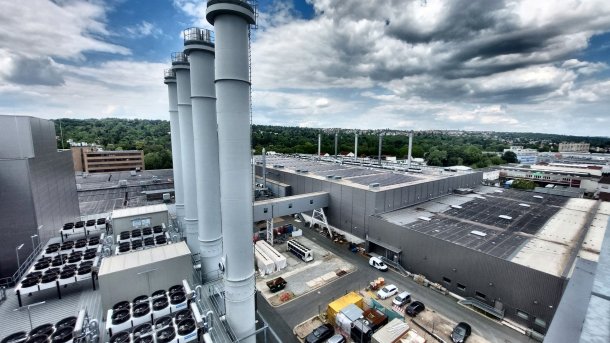
View over Equinix data centers in the east of Frankfurt
(Image: c’t Magazin)
Germany is falling behind when it comes to data centers. "In the USA, two to three times as much new capacity is added every year as is installed in Germany," explains Bitkom CEO Dr. Bernhard Rohleder.
The capacity of data centers in Germany is growing more slowly than demand. According to Bitkom, this is why local companies and authorities are forced to book cloud capacity in other countries: a creeping loss of digital sovereignty.
Data centers in Germany currently have an IT connection capacity of 2.7 gigawatts, which is expected to rise to 4.8 gigawatts by 2030. In contrast, the United States currently has 48 gigawatts (GW) and will have around 95 GW by 2030, around twenty times more capacity than Germany.
At the same time, demand is growing rapidly. Europe's largest internet exchange DE-CIX, for example, is reporting a new throughput record of more than 18 terabits per second.

(Image: Bitkom)
In particular, large cloud and hyperscale data centers with more than 5 megawatts (MW) are on the rise, already accounting for 48 percent of total capacity in Germany – although there are only around 100 of them. Around 2000 other data centers each offer space, power supply and cooling systems for server racks with a total of between 100 kilowatts and 5 MW.
Videos by heise
Hotspot Frankfurt
It is no coincidence that DE-CIX is located in Frankfurt, spread across several data centers run by different operators. This is because Frankfurt remains the most important German region for data centers: 1.05 gigawatts of connected load for servers, network and storage technology are available here, i.e. around 38 percent of the total German capacity. This is set to grow 2.7-fold in the coming years, with around 1.8 GW planned, according to the study conducted by the Borderstep Institute for Bitkom. The Berlin region is catching up fast.
Within Europe, Germany has the largest capacities, with Ireland in second place with around 2.3 GW. In addition to Frankfurt, London, Amsterdam, Paris and Dublin (FLAPD) are particularly important.
Energy efficiency washes quickly
According to the Borderstep Institute, German data centers will consume around 20 billion kilowatt-hours (20 TWh) of electrical energy in 2024, which is 0.69 percent of the total energy consumed in Germany. In relation to the total domestic electricity consumption of around 520 TWh, this is still around 3.8 percent.

(Image: Bitkom)
The majority of data centers purchase green electricity or buy certificates for it: 66% are climate-neutral in terms of their carbon footprint. By 2030, 80% of data centers' energy requirements are expected to be covered by renewable energies. At 6.5 million tons of CO₂ equivalent, data centers currently account for around 1 percent of total greenhouse gas emissions in Germany. By 2030, this figure is expected to be 4.5 million tons, despite a multiplication of capacity.
Bitkom criticizes the high electricity costs in Germany as a locational disadvantage compared to France, for example, but praises the very good security of supply.
Many data centers already use the waste heat from their servers, but only 7 percent use more than 50 percent. 45% are planning to use waste heat in future projects, which the Energy Efficiency Act also requires under certain conditions. Bitkom is calling on legislators to improve the framework conditions. 69 percent of 51 experts from data centers surveyed said that there were no customers for their waste heat.

AI power consumption is growing strongly
AI applications are already running in around 44 percent of data centers, but usually only on a small scale. AI only accounts for a larger proportion of capacity in 15 percent of data centers.
However, Bitkom expects strong growth in AI applications. Among other things, Microsoft is building huge data centers in the Rhineland region, and there are also plans for 100 MW data centers in Berlin and Hanau, for example.


(ciw)

