


Raspberry Pi module CM5 with up to 16 GB RAM and ECC error protection
The technology of the Raspberry Pi 5 is also available as the Compute Module 5 plug-in module and offers special features, e.g. more RAM with error protection.
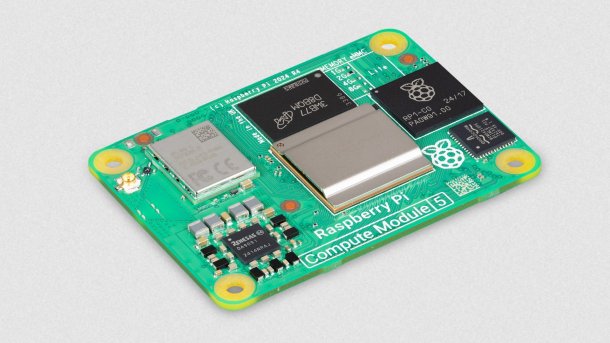
Raspberry Pi Compute Module 5 (CM5)
(Image: Raspberry Pi Plc.)
There are also modular variants of many Raspberry Pi generations. These Compute Modules are intended as embedded components for other devices, such as industrial controllers or control cabinets. The new Compute Module 5 (CM5) contains the chips of a Raspberry Pi 5.
The CM5 has the same design as the CM4, which has been available since 2020, but has a slightly different pin assignment and some special features. For example, the CM5 protects the contents of the RAM with Error Correction Code (ECC) and the maximum capacity of the main memory is up to 16 GB. In contrast, the Raspberry Pi 5, like its predecessor Raspi 4, is currently available with a maximum of 8 GB.
Videos by heise
With the exception of the WLAN antenna –, the interfaces of the Compute Modules are – on two tub connectors and can only be used via a so-called breakout or I/O board. Together with the CM5, the Raspi developers are presenting a new CM5 IO board (CM5IO), which also has a socket for an M.2 SSD. There is also a suitable heat sink for the CM5 and a sheet metal housing for the IO board.
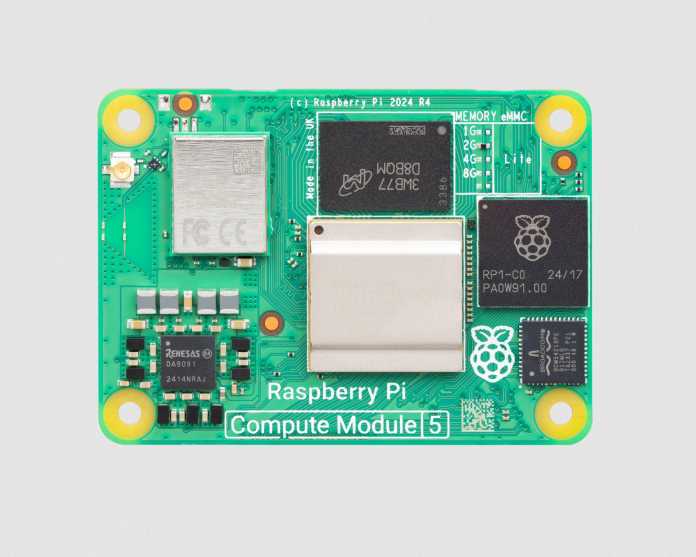
Raspberry Pi Compute Module 5 (CM5) (5 Bilder)
Raspberry Pi Plc.
)Like the Raspi 5, the CM5 is equipped with the Broadcom BCM2712 system-on-chip with four ARM Cortex-A76 cores (still with up to 2.4 GHz) and the RP1 I/O chip, which provides USB 3.0, Gigabit Ethernet and a PCIe lane (PCIe 2.0 x1, conversion to PCIe 3.0 possible at your own risk).
Like the Raspi 5, the CM5 is designed for operation with 5 volts; the power supply unit should be able to handle 5 amps. The CM5IO has a USB-C socket for the power supply. The USB-C power supply sold by the Raspi makers themselves is still one of the very few that can handle the unusual current-voltage combination of 5 V and 5 A for USB-PD.
Mass storage on the module
Like its predecessor, the CM4, the CM5 is also available with soldered eMMC flash memory, with a choice of 16, 32 or 64 GB capacity. The Lite version comes without eMMC flash; only this version can use the SDIO contacts for a (micro) SD card reader.

(Image: Revolution Pi)
The CM5 is also available with or without a wireless module for WLAN and Bluetooth (Wi-Fi 5 with 2.4 and 5 GHz, BT 5.0/BLE, Infineon Airoc CYW43455). In addition to an onboard antenna, it also has a u.FL connection for an external antenna (switchable via dtparam).
The CM5 can be ordered in 32 variants (with/without WLAN, with 2/4/8/16 GByte LPDDR4-4267 SDRAM, with 0/16/32/64 GByte eMMC flash), the list prices without VAT range from 45 to 135 US dollars.
The CM5IO costs 20 US dollars, the housing 15 US dollars and the heat sink 5 US dollars.
Other companies such as Pineboards.io are also planning to launch I/O boards for the Raspberry Pi CM5.
Empfohlener redaktioneller Inhalt
Mit Ihrer Zustimmung wird hier ein externer Preisvergleich (heise Preisvergleich) geladen.
Ich bin damit einverstanden, dass mir externe Inhalte angezeigt werden. Damit können personenbezogene Daten an Drittplattformen (heise Preisvergleich) übermittelt werden. Mehr dazu in unserer Datenschutzerklärung.
Empfohlener redaktioneller Inhalt
Mit Ihrer Zustimmung wird hier ein externer Preisvergleich (heise Preisvergleich) geladen.
Ich bin damit einverstanden, dass mir externe Inhalte angezeigt werden. Damit können personenbezogene Daten an Drittplattformen (heise Preisvergleich) übermittelt werden. Mehr dazu in unserer Datenschutzerklärung.


(ciw)


