


Lauterbach on health data: Google, Meta, and OpenAI announce interest
Lauterbach sees patient records as a treasure trove of data for AI innovations. Tech giants are showing interest in improving healthcare.
(Image: heise online / mack)
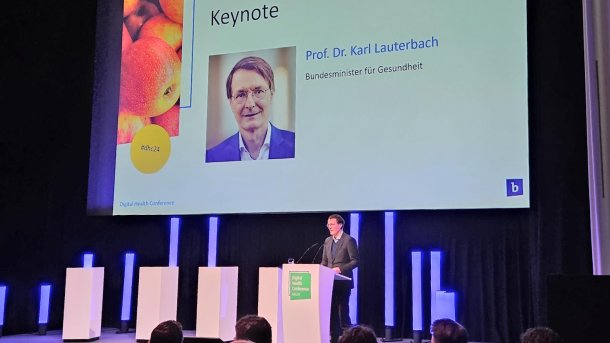
According to Health Minister Karl Lauterbach, the electronic patient file was initially a quarry. It had significant shortcomings and errors, but the late introduction was a gain because it allowed new technical possibilities to be integrated. Karl Lauterbach opened his keynote speech at Bitkom's Digital Health Conference with these words. "For 20 years, the digitalization of the German healthcare system was slow. After a successful race to catch up, the electronic patient file for 70 million insured persons is now coming on January 15. It is the heart of digitalization in the healthcare system and will dramatically improve patient treatment," promises the Federal Minister of Health.

At present, X-ray images or doctor's letters have to be transported in envelopes, and incomplete findings are no exception. A doctor-patient consultation usually takes four to six minutes. If the findings or medical history are not available, appointments with specialists have to be postponed. According to Lauterbach, patients find it difficult to summarize findings in their own language. Without clear findings, however, misdiagnoses occur. Germany is the most expensive healthcare system in Europe, but there are still quality deficits. "For the first time, we now have a life expectancy that is below the EU average," said Lauterbach. This is "of course not only due to the lack of digitization, it is also due to deficiencies in preventive medicine, we have major deficits in hospital care, but our system, we simply have to say, our healthcare system is very expensive and mediocre at best".
Three major reform blocks that Lauterbach has tackled are intended to remedy this: digitalization, hospital care and medical research. More than ten years ago, Germany was a world leader in medical research and then fell further and further behind. Germany is still among the top ten. However, other countries are further ahead in terms of digitalization. He described the electronic patient file and the Health Research Data Center (FDZ Gesundheit) at the Federal Institute for Drug and Therapy Safety as two suns "around which the other planets orbit".
Very valuable treasure trove of data
In future, all data will routinely flow into the ePA – laboratory findings, imaging data, hospital data, drug data, data from care and digital health applications. "If you now [...] realize how big this treasure trove of data is. We have one billion doctor-patient contacts in practices every year," says Lauterbach. Without the option to object to the ePA, these extensive data donations would not be possible. This treasure trove of data is growing day by day at the FDZ Gesundheit, which is also to be supplemented by further data from more than 400 medical registers and genome data.
The health insurance companies' billing data is already stored there, and in future all data will be linked via a pseudonymized health insurance number. In addition to individual therapy decisions, this should enable clinical studies, epidemiological evaluations and better healthcare policy. "What is very important is that this data set will be usable with artificial intelligence," said Lauterbach. The data set will be used to train AI systems to build their own generative AI. The structure has already been designed to be "AI-ready" from the outset. The minister was advised by Israel. Data protection and data use were "balanced" for this.
"For example, the data set is now structured in such a way that 'confidential computing' is possible in the research environment of the research data center, because the data in this environment [...] is no longer encrypted," explains Lauterbach. This means that researchers will have access to the data after a successful application, whereby the purpose of the research is decisive and not who submits the research application. According to Lauterbach, "the data set never leaves this secure environment". Researchers are also able to use the data set with AI, but the data never leaves the trusted execution environment.
From 2025, the ePA and the FDZ will be used to collect data from children to the elderly – representative of the entire population. Lauterbach described the ePA as the largest digital project ever in Germany and a leap forward in innovation. The aim is to create the "largest", "most representative" and "most interesting" health data set in the world.
Videos by heise
OpenAI, Google, Meta register interest
"This is why the manufacturers of all major AI systems are also interested in this data set. We are in talks with Meta, with OpenAI, with Google, everyone is interested in using their language models for this data set or working on this data set," says Lauterbach. Of course, they are also "trying to bring German solutions forward, I can assure you of that, but I can also assure you that there will be a great deal of interest in this data set worldwide".
Lauterbach also hopes for AI in the early diagnosis of diseases. It is increasingly possible to "recognize very early stages of cancer through fingerprints, which in principle can be seen in the protein structure of the blood". More reliance should be placed on AI for second opinions, which would reduce the burden on the healthcare system. Instead of having to flood the entire body with chemotherapy, new methods should be used for a more targeted approach. Lauterbach also has high hopes for methods such as gene therapy or CAR T-cell therapy. He also mentioned his prime example AlphaFold and EvolutionaryScale's ESM3. In the next few years, "15 million baby boomers [...] will retire from working life and will increasingly no longer be treating patients, but patients." Better medicine is possible, but Lauterbach also described medicine as a fantastic industry. "Everyone can see how we are currently stagnating economically, but this is not the case in the areas of medicine, digitalization, medical products and pharmaceuticals, where we have growth everywhere," Lauterbach said happily.
Praise from TK boss
Lauterbach received much praise for his reforms from the head of the Techniker Krankenkasse, Jens Baas. The introduction of e-prescriptions under Lauterbach worked well, apart from "minor hiccups". The minister had brought many things forward, but it was still important to keep an eye on costs. In terms of digitalization, a "fundamentally different approach or way of thinking" is needed, Baas said with annoyance.
Discussion about the visibility of billing data
Baas referred to a discussion with the government in which the idea of changing something about the display of billing data in the electronic patient file came up: "Now someone has noticed that it would be quite stupid to fill electronic patients with current billing data", "that the patient is HIV-positive". The plan with the ePA 3.0 is that it will be automatically filled with billing data that every treating doctor can automatically see. According to Baas, if you don't want the doctor to see the data, you should lock them out of their ePA completely. "That's a stupid idea, but it could have been done," said Baas. He criticized the fact that suddenly "such discussions [...] arise, that some interest group suddenly decides that there [...] could be a data topic that perhaps somehow enables the doctor to see something that he should not see". This is not the way to make progress with digitalization. In Germany, the mindset is to want to take everyone with you, "even all the skeptics".
According to a recent Bitkom survey, digitization in the healthcare sector is progressing too slowly for 7 out of 10 respondents. However, 83% of respondents have the impression that doctors are generally open to digitalization. 77 percent of respondents believe that Germany is lagging behind in international comparison. "With the Digital Act and the Health Data Utilization Act, two important projects were implemented in the shortened legislative period – the years of stagnation in the healthcare sector have thus been overcome. If Germany makes even better use of the potential of digitalization, our healthcare system will remain efficient and affordable despite all the challenges," said Bitkom CEO Dr. Bernhard Rohleder, praising the Minister of Health.


(mack)

