

Electric car Ford Puma Gen E: It will have a hard time
With the Puma Gen E, Ford is presenting an electric car that would probably have a good chance on the market. However, the key data are not very promising.
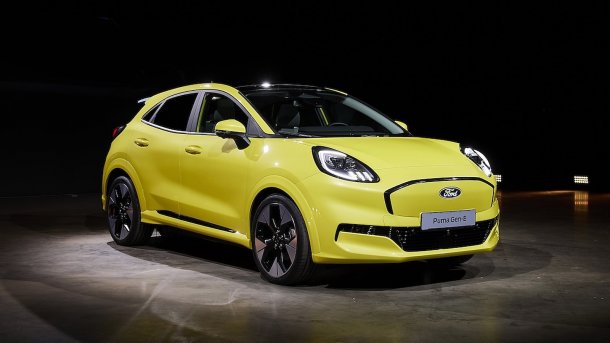
Yellow is the only color that is available at no extra charge.
(Image: press-inform)
Amidst the media hullabaloo surrounding the demise of the Volkswagen brand, VW Passenger Cars, the tense situation at Ford is almost being overlooked. The plant in Saarlouis is being closed down and numerous jobs are to be lost in Cologne. One reason for this is a model policy that rather unerringly misses the majority of loyal customers. Numerous bestsellers of the past are history or will soon be. In addition, the brand only had the Mustang Mach E to offer at a time when taxpayers were giving buyers of new electric cars a big helping hand. Now they want to take off with the Explorer, Capri and Puma. However, the Puma Gen E, the smallest E-SUV, leaves some question marks with its key data.
Ford is using a visually familiar base for the battery-electric Puma, which will also continue to be offered with petrol engines. At 4.21 m, the SUV is slightly shorter than a VW Golf and a few centimeters longer than an Opel Mokka. Ford promises an astonishing amount of space in the trunk, which offers 523 liters. There is a further 43 liters under the front hood. As part of the facelift, the entertainment electronics have recently been modernized. We expect Ford to integrate a useful load planner from day one.

Rather not for the long haul
However, the Puma's key technical data does not make it an obvious choice when it comes to long distances. Ford promises that the battery can be charged from 10 to 80 percent in 23 minutes. However, only around 30 kWh net are recharged in this time, as the total net battery energy content is just 43 kWh. In the configurator, Ford refers to this battery as "Standard Range", which gives rise to the hope that more will be added at this point. A small battery in the base model is not necessarily a bad strategy; not every driving profile requires long-distance capability.
Ford Puma Gen E (3 Bilder)

press-inform
)The Puma is also not at the forefront when it comes to charging performance. At its peak, Ford quotes 100 kW at the DC charging station. There is still no information on the AC charging capacity, so perhaps Ford will surprise us with a 22 kW charger. There are no savings elsewhere: the price list mentions standard preconditioning of the battery, but not a heat pump. In the WLTP, Ford promises consumption of between 13.1 and 14.5 kWh/100 km, depending on the tire format selected. The range in the cycle is up to 374 km. This is probably a very optimistic estimate. The electric motor delivers 124 kW and offers a maximum torque of 290 Nm. This is enough to accelerate the e-SUV to 100 km/h in eight seconds, with a top speed of 160 km/h. The permissible towing capacity is 750 kg.
Videos by heise
The surroundings
With its comparatively small battery, the Puma Gen E would be a competitor for the electric versions of the Opel Frontera and Citroën C3 Aircross. These are more simply lined and offer a similarly large storage capacity. However, they are around 20 cm longer, offer significantly more interior space and cost several thousand euros less as a base model. Ford charges a valiant 36,900 euros for the entry-level model of the Puma Gen E. The new Skoda Elroq also comes at a lower price with more space and a slightly larger battery that can be charged more quickly. The same applies to the Kia EV3, which has 58 kWh in the base model. Whichever way you look at it, Ford salespeople will be faced with a challenging product argument. A killer feature with which the brand could explain the comparatively high price is not on the horizon for the time being.
(mfz)