


Temporary e-tattoo on the scalp records brain waves
An e-tattoo applied to the scalp could record brain waves in the future. Even short hair does not interfere with the 3D-printed electrodes and conductor paths.
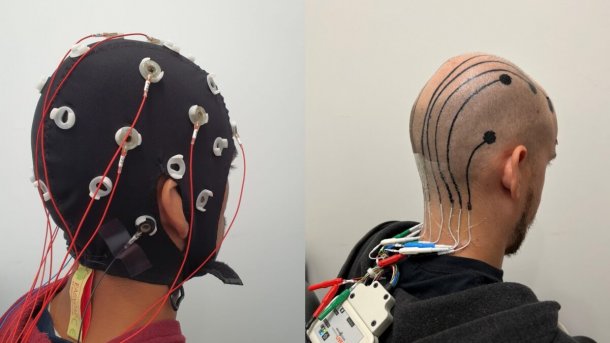
Instead of applying an electrode cap (left) or sticking electrodes on individually, a robot sprays the e-tattoo (right) onto the scalp in a single operation.
(Image: University of Texas)
Neurologists use electroencephalography (EEG) to measure brain waves and thus the electrical activity of the brain. To do this, they have to attach electrodes to the patient's skull from the outside, placed as precisely as possible and connected to an EEG monitor with cables. Electrodes and cables restrict the patient's freedom of movement and can easily detach from the hairy scalp.
Researchers at the University of Texas at Austin have now developed a 3D-printed alternative. A robotic arm applies their so-called e-tattoo directly to the scalp. It consists of various polymers, some of which are electrically conductive. The printing process creates electrodes directly on the scalp and wires that lead to connections in the neck. The freshly printed e-tattoo hardens in just a few minutes and can be sprayed onto the skin, even past short hair. Short cables then connect the printed leads to a portable, commercially available EEG monitor.
Videos by heise
"We hope that our technology can help patients to wear EEG electrodes comfortably and mobile over a longer period of time and thus facilitate long-term examinations," says project manager Nanshu Lu. In addition to medical EEGs, the e-tattos could also be used for brain-computer interfaces. People with restricted mobility could use them to control a wheelchair with their thoughts, for example. The design is ultra-flat and does not disturb patients, emphasizes co-author José del Millán.
At present, the e-tattoo can still be destroyed and removed with a hair wash. In further tests, Lu and his team want to increase the robustness and adhesion of the electrodes and leads so that patients do not damage them while sleeping. They are also working on an extension that will allow the robot to apply e-tattoos to the scalp through long hair. The plan is to use robotic fingers to push the hair aside and then spray the e-tattoo past it.


(agr)


