


Fraunhofer and Droniq succeed in 180 km long-distance drone flight out of sight
A long-haul flight of an unmanned drone was intended to demonstrate that the safe operation of drones within manned aviation over the sea is possible.
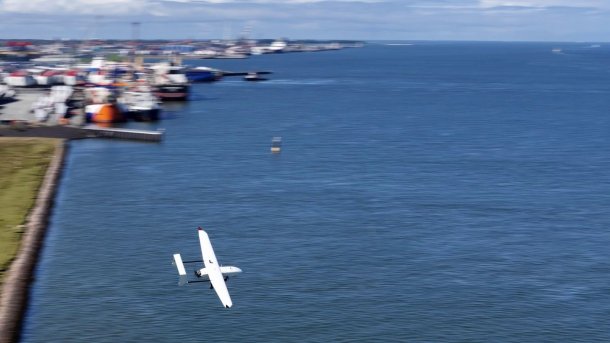
The HAS S360 drone on its way over the North Sea.
(Image: Fraunhofer IFAM)
The Fraunhofer Institute for Manufacturing Technology and Advanced Materials (Fraunhofer IFAM) and drone flight specialist Droniq have successfully completed a 180 km flight with a drone from Cuxhaven to the North Sea island of Helgoland and back again. The entire test flight took place beyond the pilot's visual range (Beyond Visual Sight of Line – BLOS). The civilian air and ship traffic on the route was taken into account.
A HAS S360 Mk.II drone from Bremen-based drone company Hanseatic Aviation Solutions was used for the test flight. The drone is a fixed-wing aircraft with a wingspan of 3.6 meters. It can carry payloads of up to 5 kg. With a take-off weight of 25 kg, it can reach a top speed of up to 100 km/h. The drone is powered by a combustion engine.
Fraunhofer IFAM and Droniq, a joint project of Deutsche Flugsicherung and Deutsche Telekom, launched the HAS S360 Mk.II from the Offshore Drone Campus Cuxhafen (ODCC). From there, the unmanned drone set course for the Elbe estuary and then towards the shipping lane to Helgoland and from there back to Cuxhaven. It covered a total distance of 180 km.
The flight was coordinated from an ODCC ground station. The entire flight was coordinated with civil aviation and shipping. Various on-board systems such as aeronautical radio, satellite communication and transponders ensure a safe flight at an altitude of more than 200 meters. The drone is also equipped with a parachute and a buoyancy aid for an emergency splashdown.
Droniq's ground sensors keep the pilot informed of the current air situation throughout the flight.
Videos by heise
Integration into manned aviation
The aim of the test flight was to check the communication links, the flight radio and the interaction of the individual systems on an unmanned long-haul flight.
With this test flight, Fraunhofer IFAM and Droniq have shown that it is possible to operate unmanned aerial drones together with manned air traffic over longer distances at sea. In the future, further flights could be carried out over the North Sea and Baltic Sea. Areas of application for such long-range drones include the monitoring of shipping lanes, the surveillance of critical infrastructure and deployment in maritime emergencies.
Fraunhofer IFAM and Droniq are planning further test flights for 2025 to be able to integrate long-range drones into the airspace in the future.



(olb)

