


Teardown: The Raspberry Pi 500 has space for an SSD and Ethernet power supply
A look at the Raspberry Pi 500 keyboard computer shows that variants with M.2 SSD and Power-over-Ethernet (PoE) could follow. There is also an RP2040 inside.
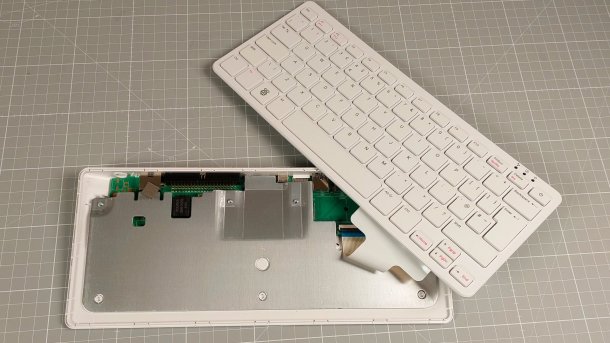
Raspberry Pi 500 with open housing.
(Image: c’t Magazin)
The new Raspberry Pi 500 keyboard computer is basically a Raspberry Pi 5 built into a keyboard – at least that's about it. Because there are some differences in the details, as our look inside the housing shows.
Videos by heise
The Raspberry Pi 500 has an entirely different circuit board to the Raspi 5, but the main chips are the same: the Broadcom BCM2712 system-on-chip has four ARM Cortex-A76 cores with a clock frequency of up to 2.4 GHz. The BCM2712 binds an LPDDR4-4267 SDRAM with 8 GByte capacity to – presumably a multi-die package with four 16 gigabit dies (64 GBit = 8 GByte).
Blick in den Raspberry Pi 500 (8 Bilder)

c’t Magazin
)The RP1 chip developed by Raspberry Pi Plc. itself serves as a kind of chipset, it is connected to the BCM2712 via PCI Express and contains controllers for USB and Ethernet, among others.
The RJ45 socket is coupled to the RP1 via the BCM54213 phy chip and a transformer from Bourns. The 40-pin GPIO strip is also connected to the RP1.
The MicroSD card reader and the WLAN/Bluetooth adapter (Infineon Airoc CYW43455) are connected via SDIO. The micro HDMI sockets are operated by the BCM2712.
Differences to the Raspi 5
The circuit board of the Raspberry Pi 500 is around 14 centimeters long because it carries all the sockets of the device, which are all arranged next to each other.

(Image: c’t Magazin)
There is space on the large board for optional components, which are not fitted to our test sample. The space for an M.2 SSD in the 2230, 2242, 2260 or 2280 design immediately catches the eye. However, the socket required for installation is missing.
Solder pads and the label "PoE" are visible in the area of the network socket. There is obviously space here for a circuit for Power-over-Ethernet (PoE), i.e. powering the Raspi 500 from the Ethernet cable. The board even has a cut-out for a PoE transformer.
A relatively large aluminum plate dissipates the waste heat from the BCM2712 so that the Raspberry Pi 500 does not need a fan (passive cooling). The housing has air slots on the underside.
Empfohlener redaktioneller Inhalt
Mit Ihrer Zustimmung wird hier ein externes Video (TargetVideo GmbH) geladen.
Ich bin damit einverstanden, dass mir externe Inhalte angezeigt werden. Damit können personenbezogene Daten an Drittplattformen (TargetVideo GmbH) übermittelt werden. Mehr dazu in unserer Datenschutzerklärung.
Raspi brand keyboard controller
Raspberry Pi Plc. uses chips developed in-house wherever possible and therefore uses the Raspberry Pi RP2040 microcontroller as the keyboard controller. It connects the keyboard matrix via an FPC cable and is connected to the RP1 via USB 1.1. The firmware for the keyboard is stored in a (Q)SPI flash memory chip.
The RP2040 occupies one of the two USB 2.0 ports of the RP1, which is why only three USB A sockets can be used externally: Two USB 3.0 (aka USB 3.2 Gen 1 with 5 Gbit/s) and one USB 2.0. The Raspi 5 has two USB 2.0 sockets.

Empfohlener redaktioneller Inhalt
Mit Ihrer Zustimmung wird hier ein externer Preisvergleich (heise Preisvergleich) geladen.
Ich bin damit einverstanden, dass mir externe Inhalte angezeigt werden. Damit können personenbezogene Daten an Drittplattformen (heise Preisvergleich) übermittelt werden. Mehr dazu in unserer Datenschutzerklärung.


(ciw)

