


Official launch of EU satellite program IRIS2
On Monday, the EU Commission signed the contract with the industrial consortium Spacerise, which is to launch 290 satellites into orbit.
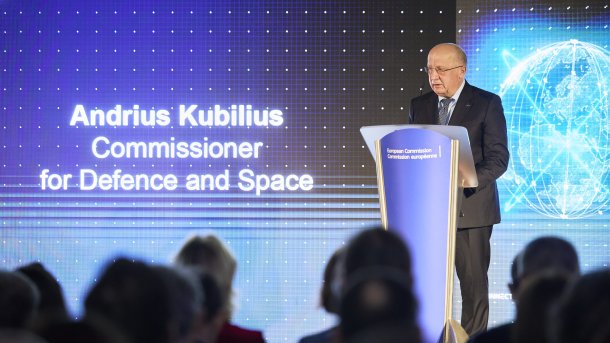
The EU Commissioner for Defense and Space, Andrius Kubilius, at the signing ceremony in Brussels on Monday.
(Image: EU-Kommission/Claudio Centonze)
The EU Commission signed the contract for the European satellite constellation IRIS2 on Monday. This commissions the Spacerise consortium to launch a network of 290 satellites for broadband coverage into medium and low orbits by 2030.
IRIS2 stands for "Infrastructure for Resilience, Interconnectivity and Security by Satellite". Spacerise is to develop the multi-orbital constellation, launch it into orbit and operate it. The consortium includes the satellite operators SES, Eutelsat and Hispasat as well as the defense companies Airbus and Thales. The network operators Deutsche Telekom and Orange are also involved.
"Exorbitant" rise in costs
The EU now puts the cost of the project at 10.6 billion euros. Around 6.5 billion euros of this is to come from public funds and the rest from the members of the consortium. Originally, the project was estimated at 170 satellites and total costs of around 6 billion euros, of which the public sector was only to contribute 2.4 billion.
Federal Economics Minister Robert Habeck (Greens) had criticized the "exorbitant" cost increase in a letter to the then EU Internal Market Commissioner Thierry Breton and called for the project to be restarted. The move had caused irritation in Brussels and was seen as an attempt by the German government to intervene in favor of the German space industry.
Videos by heise
With IRIS2, the EU states want to establish a highly available network for seamless digital communication on the continent. At the same time, it is intended to make the EU independent of US providers such as Space X Starlink or Amazon's Project Kuiper. "Today we are not just launching a satellite project. We are launching a vision – a vision of a stronger, more connected and more resilient Europe," said EU Commissioner for Defense Andrius Kubilius at the signing ceremony on Monday.


(vbr)


