

Autonomous driving: Mercedes is allowed to drive up to 95 km/h (Level 3)
German Federal Motor Transport Authority permits Mercedes-Benz to drive correspondingly equipped S-Class and EQS models autonomously on highways up to 95 km/h.
(Image: Mercedes-Benz)
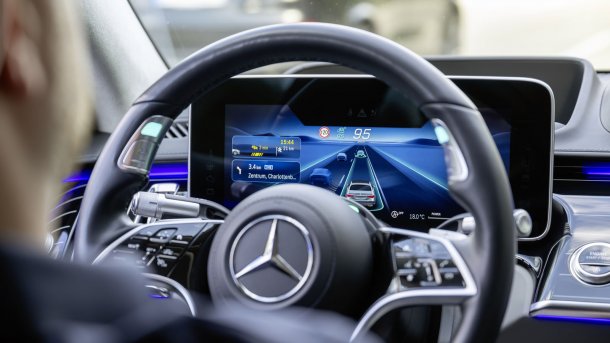
Mercedes-Benz has received approval for its semi-autonomous driving system to be used under certain conditions up to 95 km/h and thus faster than the previously permitted 60 km/h. The German Federal Motor Transport Authority (KBA) has thus approved the world's fastest certified system for highly automated driving at SAE level 3 in a series-production vehicle, according to Mercedes. The system has been available as an optional extra for the Mercedes-Benz S-Class and EQS models under the name "Drive Pilot" since May 17, 2024. The software required for the extension – does not need to be modified on the vehicle side – can be installed either by the workshop or as an OTA (over-the-air update).
"Simply relax"
Until now, cars have been allowed to drive autonomously on the highway up to 60 km/h in traffic jams under certain conditions. With the further development that has now been approved, it will be 95 km/h in the normal flow of traffic behind a vehicle in front in the right-hand lane of the highway. Mercedes-Benz writes that drivers can watch movies, read the newspaper, work "or simply relax at the wheel while the Mercedes drives in a highly automated manner".
If necessary, Drive Pilot can hand the driving task back to the person behind the wheel. If the driver does not react, the system is able to perform "a safe emergency stop that can be controlled by the traffic behind". Highly automated driving at level 3 means that the person behind the wheel must be ready to take control of the car at any time when asked to take back control.

The more, the better
The long-established company aims to make its cars faster, longer, more comfortable and safer to drive automatically in the future. In Germany, highly automated driving is currently limited by law to 130 km/h. It is an important goal that Mercedes is striving to achieve for its automated driving by the end of this decade. For Mercedes-Benz, the following applies: "The more vehicles drive automatically, the safer road traffic becomes."
Among other things, 35 sensors, including cameras, radars, ultrasonic sensors and LiDAR, form the basis for more reliable detection and recognition of the surroundings using various physical principles. Highly accurate map material already serves as the basis for centimeter-precise positioning, which is also necessary for further development.
Videos by heise
The price of Drive Pilot equipment remains unchanged. In the Mercedes S-Class it costs 5950 euros, in the Mercedes EQS electric car (test) it costs 8842 euros because it is linked to a driving assistance package. Vehicles already equipped with it will receive the update free of charge, Mercedes-Benz writes today. The company has set spring 2025 as the expected sales launch date in Germany.
(fpi)