


Project Digits: Nvidia shrinks AI system DGX into a mini PC
Project Digits is a powerful mini PC with a highly integrated ARM SoC and integrated Blackwell GPU.
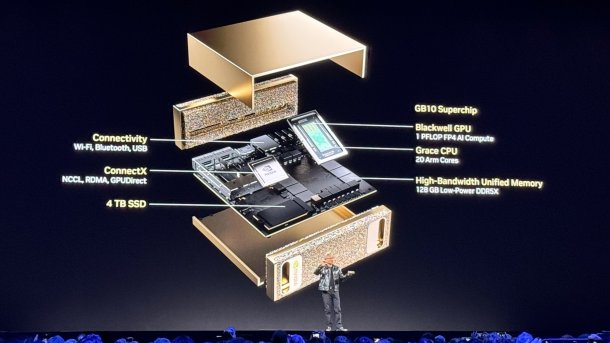
(Image: c't / mue)
Nvidia CEO Jensen Huang used his keynote speech not only to announce the GeForce RTX 5000 family (more on this later in a separate report) and his vision of how AI will change the world of automation, robotics, and cars. But also to announce a future hardware product for the near future. Although the product will be available in May for 3000 US dollars, it does not yet have an official name: Huang announced it as Project Digits.
This is a workstation in mini-PC format designed for AI tasks. In terms of computing power, it should be in no way inferior to previous DGX systems, which have to be plugged into server cabinets in data centers: Nvidia promises that AI models with 200 billion parameters can run on it. And if that's not enough, two units can be connected via ConnectX – for models twice as large.
Videos by heise
ARM SoC with integrated Blackwell GPU
At the heart of Project Digits is an SoC called GB10, which marries a Blackwell-generation GPU with 20 ARM cores (Grace). This is joined by 128 GB of LPDDR5 RAM on the motherboard. Nvidia does not provide any information on the bandwidth, but we assume that the memory interface is likely to be more than 128 bits, similar to Apple's M4 Pro or AMD's recently launched Ryzen AI Max. An SSD (according to render images in M.2-2242 format) with up to 4 TByte is planned as mass storage and the Linux-based DGX OS as the operating system.
What is remarkable about GB10 is that Huang explicitly emphasized at the presentation that MediaTek was involved in the development of the SoC. The CEOs of both companies had already displayed a close bromance on stage at Computex around six months ago. Both companies are also rumored to have ambitions to enter the growing Windows-on-ARM ecosystem. Currently, only Qualcomm's Snapdragon X – is part of this ecosystem, and its rather weak integrated graphics unit, which is poorly supplied with drivers, is the biggest sticking point.


It therefore doesn't take too much imagination to picture GB10 in a notebook or mini PC suitable for gaming. It is also fitting that Nvidia always presents new chip generations in high-performance versions with big price tags, while more mass-market versions for gamers have to wait several months.
Heise Medien is the official media partner of CES. (mue)


