


Nvidia introduces GeForce RTX 5090, 5080, 5070 and 5070 Ti
Four new graphics cards herald the start of Nvidia's GeForce RTX 5000 series. The top model costs an enormous 2329 euros.

Nvidias GeForce RTX 5090.
(Image: Nvidia)
Nvidia announces the first four gaming graphics cards of the Blackwell generation at CES 2025: GeForce RTX 5090, 5080, 5070 Ti and 5070. Unlike AMD, the company is disclosing all specifications and prices. It will start at the end of January. Slimmed-down laptop variants will appear for notebooks.
A major leap in performance can only be expected for the top model GeForce RTX 5090. It uses the GB202 graphics chip with 21,760 active shader cores and 32 GB of GDDR7 memory on 512 data lines (1792 GB/s). At a typical boost clock frequency of 2410 MHz, the graphics card achieves a theoretical computing power of 109 teraflops in the FP32 data format, which is important for gaming.
This is almost a third more than the GeForce RTX 4090, which achieves just under 83 teraflops with 16,384 shader cores and makes do with 24 GB of GDDR6X memory and 1001 GB/s.
Incidentally, 24,576 shader cores are physically present in the GB202 GPU. Nvidia would therefore still have a cushion for a faster graphics card – but even with the 4000 generation, full expansion was reserved for expensive professional graphics cards.
Power consumption continues to rise
Nvidia buys the extra performance with a significant increase in electrical power consumption: while the GeForce RTX 4090 still had a maximum of 450 watts as standard, the GeForce RTX 5090 has a whopping 575 watts.
This step is necessary because the responsible chip manufacturer TSMC has further optimized the production process, but no truly new production generation is used. The 4NP process used is an optimized process in the 5-nanometer class (officially "4 nm").
| Specifications Nvida RTX 5000 | ||||
| GeForce | RTX 5090 | RTX 5080 | RTX 5070 Ti | RTX 5070 |
| Shader / Raytracing / Tensor Cores | 21.760 / 170 / 680 | 10.752 / 84 / 336 | 8960 / 70 / 280 | 6144 / 48 / 192 |
| Base clock / Boost | 2010 / 2410 MHz | 2300 / 2620 MHz | 2300 / 2450 MHz | 2160 / 2510 MHz |
| Memory | 32 GB GDDR7 | 16 GB GDDR7 | 16 GB GDDR7 | 12 GB GDDR7 |
| Memory throughput | 1792 GB/s, 512 Bit | 960 GB/s, 256 Bit | 896 GB/s, 256 Bit | 672 GB/s, 192 Bit |
| PCI Express | 5.0 x16 | 5.0 x16 | 5.0 x16 | 5.0 x16 |
|
Power consumption |
575 watts | 360 watts | 300 watts | 250 watts |
| Power | 12V-2x6 | 12V-2x6 | 12V-2x6 | 12V-2x6 |
| Video ports | 3 Displayport 2.1, 1 HDMI 2.1 | 3 Displayport 2.1, 1 HDMI 2.1 | 3 Displayport 2.1, 1 HDMI 2.1 | 3 Displayport 2.1, 1 HDMI 2.1 |
| Price | 2329 euros | 1169 euros | 879 euros | 649 euros |
| Launch date | January 30 | January 30 | February | February |
Little additional performance for all others
In terms of theoretical computing power, the GeForce RTX 5080 is barely behind the GeForce RTX 4080 Super. The RTX 5080 uses 10,752 shader cores and 16 GByte GDDR7 RAM (960 GByte/s); the RTX 4080 Super uses 10,240 shaders and 16 GByte GDDR6X RAM (736 GByte/s). The boost clock frequency increases slightly by 70 MHz.
Almost all improvements must therefore come from the graphics architecture and software features. The specifications also make it clear that the gap between the GeForce RTX 5090 and GeForce RTX 5080 is even greater than with the top 4000 models.
The picture of the small performance leap continues with the smaller models: The GeForce RTX 5070 Ti uses 8960 shader cores and also 16 GByte GDDR7 RAM (896 GByte/s) (RTX 4070 Ti Super: 8448 shaders, 16 GByte, 672 GByte/s). Due to the lower clock frequency, there is hardly any computational advantage over the RTX 4070 Ti Super.
In terms of specifications, the GeForce RTX 5070 is closer to the GeForce RTX 4070 than to the RTX 4070 Super. The newcomer makes do with 6144 shader cores and still 12 GB of memory. The boost clock frequency increases only slightly.
Exclusive features instead of more performance
It is therefore not surprising that Nvidia is focusing on the integrated tensor cores for AI algorithms. The RTX 5000 series exclusively supports Deep Learning Super Sampling (DLSS) 4.
Its core feature: Multi Frame Generation (MFG). In supported games, the graphics cards can display up to three artificially generated frames between two actually rendered frames. In theory, this quadruples the frame rate. However, it remains to be seen how pretty this will look and what effect it will have on the latency of keyboard, mouse and gamepad inputs. DLSS 3 calculates a single artificial frame between two real ones and already has a significant impact on latency.
GeForce RTX 5000 Founders Editions (12 Bilder)
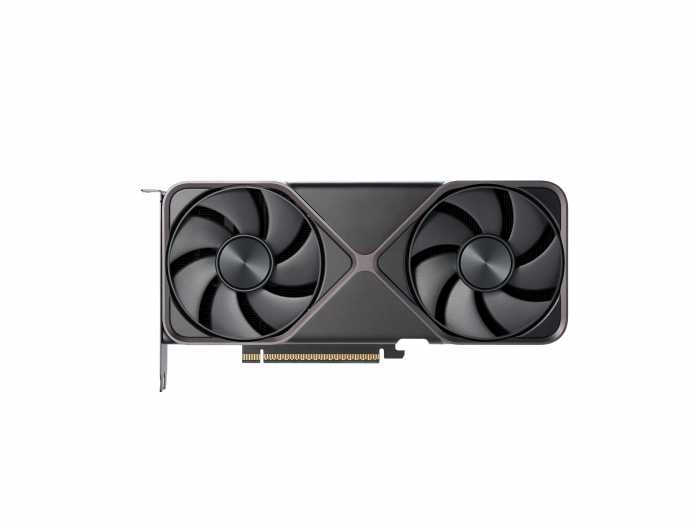
GeForce RTX 5070
Nvidia
)The GeForce RTX 5090 clearly breaks the 2000 euro barrier
Meanwhile, Nvidia is paying handsomely for its monopoly on high-end graphics cards. The GeForce RTX 5090 has a recommended retail price of 2329 euros. The GeForce RTX 5080 is priced at 1169 euros, the RTX 5070 Ti at 879 euros and the RTX 5070 at 649 euros.
The starting price of the top model thus increases by 20 percent – the GeForce RTX 4090 cost 1949 euros at market launch. With the smaller models, it all depends on the points of comparison: The GeForce RTX 4070, for example, started at 659 euros, but then gradually became cheaper. Later, the faster RTX 4070 Super appeared at the same price.
The GeForce RTX 5090 and RTX 5080 models will be released on January 30. The little sisters will follow in February; Nvidia has not yet announced the exact date.
Videos by heise
Slim Founders Editions
Nvidia is once again releasing its own Founders Editions of the GeForce RTX 5090, RTX 5080 and RTX 5070. Despite increased power consumption, all three variants only occupy two slots. With a new cooling design, the graphics cards should be able to dissipate waste heat better: The centrally positioned PCB is so small that both axial fans can blow past it – no PCB or backplate interferes with the airflow. In most cases, the processor receives more hot exhaust air, which makes it more difficult to cool.

(Image: Nvidia)
Partner manufacturers such as Asus, Gainward, Gigabyte, Inno3D, KFA2, MSI, Palit, PNY and Zotac are launching their versions of the RTX 5000 graphics cards, which are thicker than Nvidia's Founders Editions.
Heise Medien is the official media partner of CES 2025.
Empfohlener redaktioneller Inhalt
Mit Ihrer Zustimmung wird hier ein externer Preisvergleich (heise Preisvergleich) geladen.
Ich bin damit einverstanden, dass mir externe Inhalte angezeigt werden. Damit können personenbezogene Daten an Drittplattformen (heise Preisvergleich) übermittelt werden. Mehr dazu in unserer Datenschutzerklärung.


(mma)


