


NASA has two options for soil samples from Mars, decision to be made in 2026
The soil samples collected by the Mars rover Perseverance are to be scientifically examined on Earth. The costly return mission remains open.
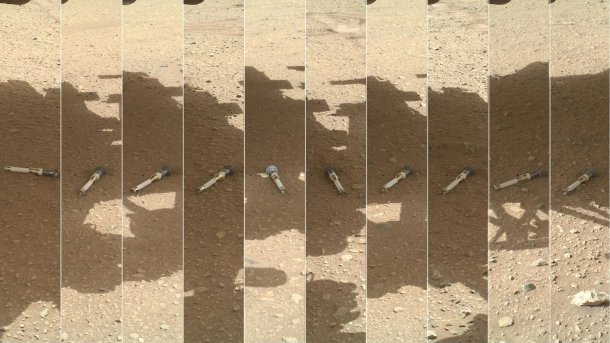
Photomontage of soil samples from Mars
(Image: NASA)
NASA has developed two alternatives for collecting the soil samples from Mars so that they can be scientifically examined in detail on Earth. However, a decision on the return will be left to the new head of NASA under the incoming Trump administration in the USA. He will take office at the end of January. However, the US space agency assumes that the final decision on the Mars Sample Return (MSR) mission will not be made until the second half of next year.
The Mars rover Perseverance has been collecting soil samples on the red planet since 2021 and packing them in numerous cigar-shaped containers. These 30 rock and dust samples could reveal clues about the history of Mars and possibly about previously possible life. A remote-controlled investigation on Mars itself would not be thorough enough, so the soil samples have to be brought back to Earth. This is technically complex, time-consuming, and expensive. Since the beginning of 2024, NASA has therefore been searching for ideas for cheaper transportation to Earth. Two alternatives have now been developed.
Return mission is complex
For the return transportation, a spaceship must take off from Mars itself, but mankind has never attempted to launch a rocket from another planet before. Landing is also problematic, as the spacecraft used to collect the soil samples is likely to have a certain mass and Mars has a very thin atmosphere, meaning that the parachutes normally used would encounter little air resistance. This is why thrusters have to slow down the landing process, as was the case with the Mars rovers.
Videos by heise
The second option is a commercial spacecraft, for example from SpaceX or Blue Origin, although in this case, NASA is counting on ideas from the respective companies. In any case, the landing vehicle, the so-called "Mars Ascent Vehicle", will be smaller than previously planned. In addition, the solar panels previously used will be replaced by a nuclear propulsion system, as this should ensure operation even during dust storms and reduce the complexity of the mission. However, NASA assumes that the soil samples will not reach Earth until 2035, perhaps even 2039. This is because the spacecraft for retrieval is not expected to be able to launch to Mars until 2030 or 2031.
NASA managers are positive
“By pursuing two possible paths, NASA will be able to return these samples from Mars with significant cost and time savings compared to the previous plan,” said NASA Administrator Bill Nelson. “These samples have the potential to transform our understanding of Mars, our universe and – ultimately – ourselves.”
“NASA's rovers are braving the harsh Martian environment to collect groundbreaking science samples,” added Nicky Fox, head of NASA's Science Section. “We want to bring them back as soon as possible to study them in state-of-the-art facilities. The Mars Sample Return will allow scientists to understand the planet's geologic history and the evolution of climate on this barren planet where life may have existed in the past, and will shed light on the early solar system before life began here on Earth. This will also prepare us to safely send the first human explorers to Mars.”
Change at the top of NASA
Former astronaut Bill Nelson will vacate his post as NASA administrator on January 20, writes Ars Technica. He will be succeeded by Jared Isaacman. Donald Trump nominated the US businessman and amateur astronaut last month. Isaacman has already flown into space twice on a spaceship operated by the private space company SpaceX, paying for both flights out of his pocket.

During the changeover at the head of NASA, Bill Nelson did not just want to leave his successor with an option for the upcoming Mars missions. But Nelson also explained: “This will be a function of the new administration to fund it.” It is considered certain that the Trump administration will also push ahead with the Mars missions, especially given the involvement of SpaceX founder Elon Musk in the business of the incoming US administration.
However, it remains unclear in what form. It is expected that the White House under Trump will place emphasis on “results and speed” in NASA's space programs. This could indicate an acceleration of manned moon landings and manned Mars missions. Because there is a new race in space: China wants to fly to Mars as early as 2028 and bring samples back to Earth.


(fds)

