


Bright giant televisions from Hisense
At CES, Hisense is showing its first micro LED TV and an LCD TV with dimmable RGB backlight for a particularly colorful display.
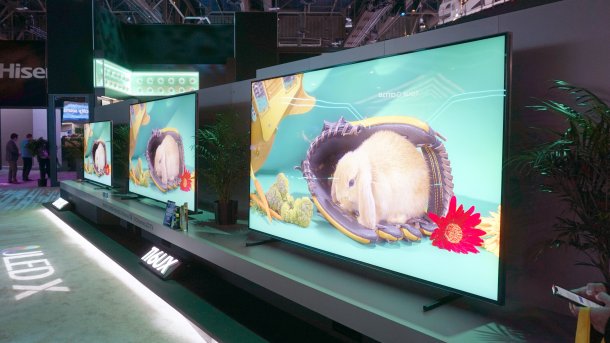
In micro LED TVs, each pixel consists of tiny light-emitting diodes. The self-illuminating displays are therefore an inorganic version of OLEDs. This has tangible advantages: Like OLEDs (Organic Light Emitting Device), they switch very quickly, have a rich black and therefore high contrast and at the same time an enormously bright, colorful display. And unlike organic displays, there is no burn-in when image content is shown on the display for a very long time.
With the 136-inch TV (3.45 meter screen diagonal) announced at CES and the 108-inch TV (2.75 m screen diagonal) shown at the stand, Hisense belongs to the small circle of micro LED TV manufacturers. The 4K display has a resolution of 3840 x 2160 pixels and is said to achieve luminance levels of up to 10,000 cd/m2. Hisense specifies a color space of 95% of the large BT2020 video color space, the refresh rate is up to 120 Hertz and can be adapted to the graphics card output via VRR (Variable Refresh Rate). Gamers can also look forward to low latency in gaming mode (ALLM).

(Image: Ulrike Kuhlmann, heise online)
HDR support
For video streaming, the display supports HDR 10 and HDR 10+ as well as Dolby Vision. The giant display with a diagonal of 3.45 meters (136 inches) will be available in 2025, but Hisense has not yet announced a price. However, it is likely to be in the six-figure range, as transferring the tiny light-emitting diodes, which are produced on small wafers, to the large display substrates is complicated and therefore very expensive.
It is also questionable who has space for such a large screen. This is probably why displays with micro LED pixels are primarily used in the business sector, for example in reception areas or at airports. So far, manufacturers have not been able to implement micro-LED technology in smaller display diagonals. At least not at a reasonable cost, as the displays would have to be comparable in price to LCDs or OLEDs for standard living room sizes of 65 inches, for example.
Videos by heise
Color dimming with mini LEDs
As a further innovation, Hisense is showing an LC display with locally dimmable red, green and blue LEDs. Normally, white LEDs light up the back of LCDs, so it is not possible to differentiate between colors when dimming.
The RGB diodes have significantly narrower spectra than the "white" backlight of blue LEDs with quantum dots or yellow phosphor coating. The color filters on the LCD can also be better matched to the RGB diodes. In this way, the screens achieve a more color-intensive display, further improved by the separate backlight control by color.
The targeted darkening of selected image segments increases the in-image contrast, although this also depends on the number of dimming zones. The finer the differentiation, the less blooming occurs.

(Image: Ulrike Kuhlmann, heise online)
Hisense calls its LCDs with dimmable RGB LED backlight "Trichroma LED TV". The Trichroma TV from the UX9 series presented at CES has a screen diagonal of 116 inches, or 2.95 meters. The RGB mini LED chips enable a slim design and their control must be synchronized with the pixel refresh. This requires some computing power, which is of course provided by an AI chip. The manufacturer does not mention the number of dimmable zones or prices; however, the Trichroma TVs will be slightly more expensive than TVs with a conventional backlight – but significantly cheaper than real micro LED TVs.
In Las Vegas, Samsung and TCL also presented TVs with such a color-differentiated backlight control.
Heise Medien is an official media partner of CES 2025. (uk)


