


Drone crashes: Amazon stops drone delivery service in Arizona and Texas
Drone crashes in rainy weather are causing problems for Amazon's delivery service. After an update, however, things should continue.
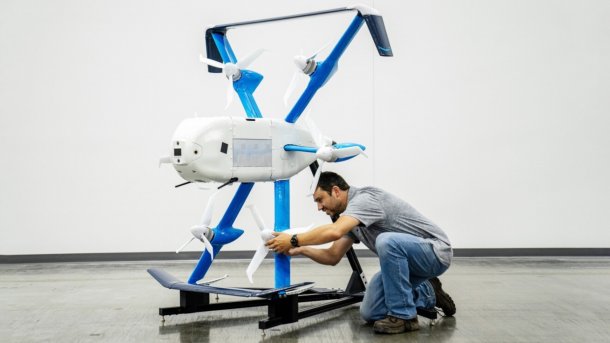
A technician on the MK30 drone from Amazon.
(Image: Amazon)
The online store Amazon has suspended its drone delivery service in the West Valley Phoenix metro area in the US state of Arizona and College Station in Texas after two crashes. This was reported by Bloomberg on Saturday. The two MK30 delivery drones, which were being tested, are said to have crashed at Pendleton Airport in Oregon in December. Amazon uses the airport for its tests. One of the two drones is said to have burst into flames in the crash.
Both crashes occurred in rainy weather. Amazon has left it open as to whether the drizzle was the cause. An accident involving two drones also occurred during a test flight back in September. The team wanted to find out how drones behave as soon as one of the rotors fails. However, the two test flights took off at the same time, causing the delivery drones to come too close to each other and collide.
New updates required
However, the crashes are not the main reason for stopping the drone deliveries, according to Amazon. There was also no corresponding instruction from the US Federal Aviation Administration (FAA) to suspend the flights. This is a voluntary measure. The company wants to use the time-out to develop updates and thus avoid further crashes.
Videos by heise
Amazon has not said whether the new update will also address and resolve the problems with flights in the rain. It is also unclear when the delivery drones will be able to take off again. After the updates, the FAA must first approve further operations.
Amazon has pinned several hopes on the new, more powerful MK30 drone. For example, it should have up to twice the range, be quieter in operation and be able to take off even in adverse weather conditions. The FAA certified the drone for operation in airspace in October 2024. This was preceded by numerous operational tests and safety checks.
Employees at the affected sites should not suffer any disadvantages as a result of the operational break. They will continue to be paid.



(olb)


