


MIT: Tiny acrobatic insect robot stays in the air for a long time
The MIT researchers were able to significantly increase the flight time of an insect-sized flapping wing robot compared to similar robots.
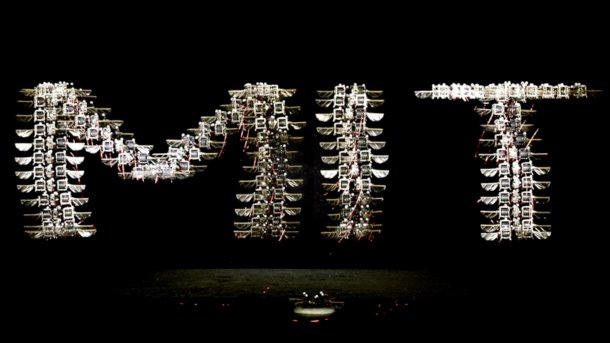
The small flapping wing robot can fly off letters with precision.
(Image: MIT)
Researchers at the Massachusetts Institute of Technology (MIT) have developed a tiny, insect-like flying robot that is more agile in the air, can perform acrobatic feats and has a longer flight time than similar flapping-wing robots. Instead of electric motors, the robot uses muscle-like actuators. The MIT scientists see a future field of application in the area of artificial plant pollination.
The MIT flying robot is the size of a beetle and weighs just 750 mg, as can be seen in the study "Acrobatics at the insect scale: A durable, precise, and agile micro-aerial robot", published in Science Robotics. The robot has four wings. Initially, the researchers had planned eight wings, but with this arrangement they found that the lift forces interfered with each other and led to lower flight performance. The version with four wings is more effective, saves space and leaves more room for the necessary control electronics.
Flapping wing drive with artificial muscles
The wings are moved by a complex gearbox that is moved by actuators with artificial muscles. This variant is more efficient than using electric motors to realize the movement, say the MIT scientists. The wing hinges used in previous versions of the flapping wing robot could now be shortened. This has a positive effect on the mechanical load and therefore on endurance. The torque has also been tripled thanks to the new design.
The actuators for moving the wings consist of elastomer layers that are clamped between two very fine carbon nanotube electrodes and rolled up into a cylinder. The actuators can expand and contract very quickly. This allows the wings to be moved mechanically. These actuators allow very high flapping frequencies, which are required to allow the flying robot to take off.
Videos by heise
Long flight duration
Conventional flapping wing robots achieve a flight duration of around 20 seconds, the scientists write. This would not be sufficient to adequately test the control system. In addition, these robots are limited in terms of flight, meaning they can only move slowly. The robot developed by MIT has a flight time of 1000 seconds. At 35 cm/s, it is fast and maneuverable. It can perform acrobatic flight maneuvers such as flips and rolls. It can also be controlled precisely. The researchers had it fly letters in the air. Such precise control is necessary so that it can later land on flowers in order to carry out artificial pollination.
Empfohlener redaktioneller Inhalt
Mit Ihrer Zustimmung wird hier ein externes Video (TargetVideo GmbH) geladen.
Ich bin damit einverstanden, dass mir externe Inhalte angezeigt werden. Damit können personenbezogene Daten an Drittplattformen (TargetVideo GmbH) übermittelt werden. Mehr dazu in unserer Datenschutzerklärung.
However, further research is needed before this is possible. Up to now, the flapping wing robot has been controlled and powered externally via cables. In addition, the researchers still need to give it a certain degree of autonomy so that it can carry out tasks independently.
The MIT scientists assume that it could take another three to five years before the integration of all components is complete. The robot should then be able to fly for much longer. With the optimization of the existing components, the researchers believe that a flight time of up to 10,000 seconds is possible, which would be more than two and a half hours.



(olb)

