


NASA tests extremely deformable wheels for Mars rovers
The wheels of rovers wear out badly on Mars. NASA is testing new types of wheels made from a special alloy that are less susceptible to deformation.
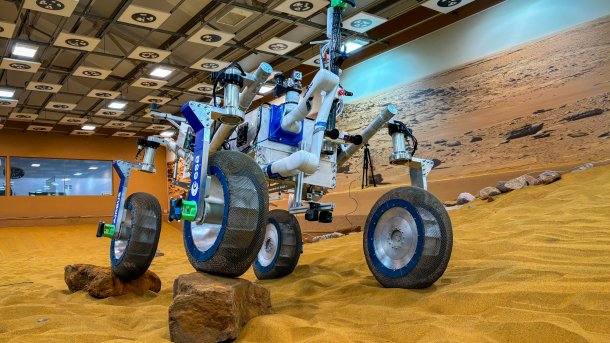
Mars rover with spring tires on the Airbus Mars test site: many possible applications for shape memory alloys.
(Image: NASA)
Mars has an uneven and rugged surface over large areas, which is very hard on the wheels of vehicles. The US space agency National Aeronautics and Space Administration NASA is testing new types of wheels for future Mars rovers, which will be less affected by sharp-edged rocks.
The wheels are to be made of metal, as on the previous Mars rovers. However, the wheels are not solid, but consist of metal springs and can deform considerably. NASA developed the spring tires together with the US tire manufacturer Goodyear Tire & Rubber and , according to its own information, tested them on the Mars simulation site of the European aerospace company Airbus.
NASA has been working with SMAs for some time
The tires consist of a shape memory alloy (SMA) made of nickel and titanium. An SMA can be bent, stretched, heated or cooled and then returns to its original shape. NASA has been using SMAs for a long time, but not yet for wheels.
Such wheels have advantages on uneven terrain such as the rocky surface of Mars: they can be extremely deformed if a rover drives over a stone, for example. Once the load is removed, the wheel returns to its normal shape. This is not possible with spring tires made of conventional metal.
Tested at Airbus
The team from NASA's Glenn Research Center tested the wheels at the Airbus Mars Yard in Stevenage, around 40 kilometers north of London. "We did a lot of testing across the slope over rocks and sand, where the focus was on understanding stability, as this was something we had never tested before," said NASA engineer Colin Creager.
NASA and Goodyear have been working on spring tires for a good 15 years. Initially they were made of steel, but this deformed permanently under load. This problem was solved by using the nickel-titanium SMA.
Videos by heise
The conditions on Mars are hard on the wheels of the rovers. Curiosity's wheels, for example, showed dents and holes. Wheels made of SMA could prove to be more durable. However, NASA materials scientist Santo Padula sees even more potential applications for these alloys: "We need new materials for extreme environments that can absorb the energy of micrometeorite impacts on the moon, for example for habitats for a large number of astronauts and scientists working on the moon and Mars."


(wpl)


