

E-cars in winter: Who comes close to the factory specification?
The ADAC has tested how comfortable electric cars are to use on long journeys in winter. The differences between the manufacturers are considerable.
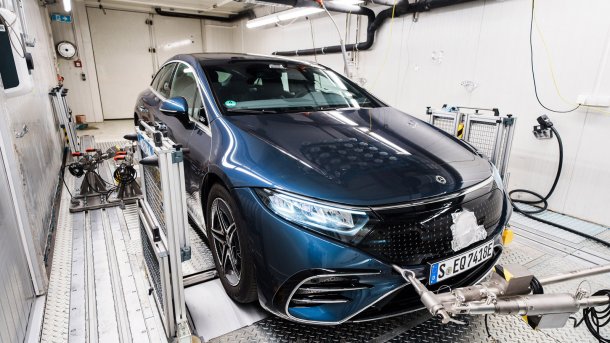
(Image: ADAC/abgedreht)
It's the classic question that many electric car owners will have heard more than once: "How far will it go?" Anyone who has used an electric car in everyday life for a certain period of time will answer: "It depends ...", because a blanket answer to this question is out of the question. Too many factors play a role to be able to give a reliable answer in one sentence. Even the ADAC cannot do this with its current test, which was not the aim. The club took a number of more or less popular models for a test in order to put them to the test under the most unfavorable circumstances imaginable for electric cars. The result was significant differences between the electric cars.
Scenario: long distance at zero degrees
The ADAC scenario is not a reflection of an average driving profile in two respects, but that does not mean it is far removed from practice. The club simulated a journey from Munich to Berlin at temperatures of around zero degrees. In the everyday lives of most drivers, such distances are the exception, and fortunately such climatic conditions do not prevail all year round. The ADAC's aim was therefore to show how e-cars perform outside of the ideal conditions depicted by the WLTP. The official consumption figure in the cycle is recorded at 23 degrees. This means that the energy requirement for air conditioning the battery cells and interior is very low.

The ADAC selected the models with the longest range from 25 manufacturers. To ensure comparability between all candidates, the test was moved to a test laboratory. The candidates selected were
- Tesla Model 3 LR RWD
- Hyundai Ioniq 6
- VW ID.7 Pro S
- Nissan Ariya 87 FWD
- Kia EV3
- GWM Ora 07 AWD
- XPeng G6 LR
- Skoda Enyaq Coupé 85
- Polestar 2 LR SM
- Cupra Born VZ
- Genesis GV60 RWD
- Ford Capri ER RWD
- Renault Scenic E-Tech 220
- BYD Seal RWD
- Peugeot e-3008 210
- Volvo EC40 SM ER
- MG4 ER
- Toyota bZ4x FWD
- Nio ET5 LR
- Porsche Taycan
- Mercedes EQS 450+
- Audi S e-tron GT
- BMW iX xDrive50
- Lorus Emeya
- Lucid Air Grand Touring AWD
Comparison of practice vs. WLTP
The test provides several insights into the candidates under winter conditions. Firstly, the range determined on a frosty highway drops to varying degrees compared to the WLTP. Nio (-21 percent), Porsche (-24) and Mercedes (-27) performed best. Instead of 531, the Nio still managed 421 km with a full battery, Porsche achieved 504 instead of 667 and Mercedes 600 instead of the promised 817 km. The situation is different for the bottom performers from Volvo, MG and Toyota. In the Volvo test, 285 of 569 km remained. The MG only managed 254 instead of 520 km and the Toyota 233 instead of 504 km.
In order to classify the figures, it is important to note that the ADAC compares the practical values of a winter highway drive with values in the cycle, which are only experienced to a small extent on the highway – and at 23 degrees Celsius. In other words: The highway candidates do not reach the reference values compared here, even at higher temperatures. The different deviations are nevertheless remarkable.
Videos by heise
Mercedes arrives without a stopover
The test started with a fully charged battery. The Mercedes was the only candidate in this test that managed the 582 km on one charge – and even had 18 km remaining range. This is due on the one hand to the very high energy content of the battery and on the other to the lowest fuel consumption in this field. It was 20.8 kWh/100 km. The last five, Volvo, Genesis, Peugeot, MG and Toyota, did not even manage half of that. If you roll up to the charging station with a charge level of 10 percent and stop charging at 80 percent to save time, you won't get from Munich to Berlin in one stop. In the case of the Toyota, even a second stop is not enough.
ADAC-Test: Elektroautos im Winter (4 Bilder)

Recharged in 20 minutes?
The annoying range debate can be defused to a certain extent if the charging stops are short, i.e. the battery is quickly ready for many more kilometers. As expected, the test field is also very far apart here. The ADAC used a charge level of 10 percent and a 20-minute break and measured how much the range increased during this time. If the local infrastructure plays along, the Porsche Taycan has recharged 370 km after 20 minutes – based on the consumption determined in this test. No other manufacturer can currently match this. Mercedes is well behind with 304 km, all the others add less than 300 km. There is a broad midfield with values between around 190 and 220 km. The e-cars in the test with the lowest recharging range in 20 minutes come from Toyota, Peugeot, Renault and GWM.
Conclusion
The ADAC test only represents a small section of an average driving profile. Nevertheless, the differences between the models are remarkable, as not every candidate is ideal for long journeys in winter conditions. Users must compare the relevance of the findings with their driving profile. Those who usually only cover short distances and drive long distances mainly in summer will weigh the results differently than someone who drives long distances all year round.
(mfz)