


Boeing makes a loss of 2 billion US dollars with the Starliner
Following the failure of the Starliner mission to the ISS, Boeing has reported further financial losses. The total is 2 billion US dollars.
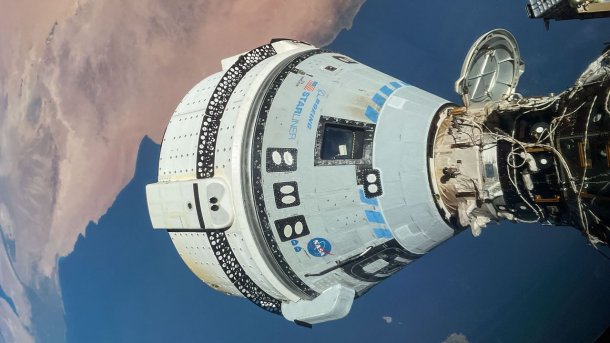
Starliner spacecraft on the ISS: 523 million US dollars loss in 2024
(Image: NASA)
Boeing's Starliner program is increasingly turning into a fiasco for the US aerospace company: the first flight to the International Space Station (ISS), which was delayed for years, was a failure. The program resulted in immense financial losses for the company.
Boeing has just published its final report for 2024. In it, the Group reports a loss of 523 million US dollars from the Starliner Commercial Crew Program. The reasons for this include “schedule delays” and “higher testing and certification costs”. In total, the losses from the Starliner program now amount to around 2 billion US dollars.
In 2014, the US space agency NASA (National Aeronautics and Space Administration) selected Boeing alongside SpaceX to fly crews to the ISS. Boeing received a budget of 4.2 billion US dollars for this. Competitor SpaceX received 3.1 billion US dollars.
Starliner was to fly to the ISS in 2016
The plan was for the Starliner to fly to the ISS unmanned for the first time in 2016. The first manned flight was to take place the following year. However, it soon became apparent that the ambitious schedule could not be met. Boeing postponed the first flight time and time again.
The time finally came in 2019. However, the first flight was not a real success: due to a software error, its engines did not ignite at the right time and the spacecraft did not reach the ISS. However, it did land safely. The Starliner did not fly to the space station for the first time until 2022.
The first manned flight to the ISS was a complete fiasco in June 2024: the spacecraft flew back to Earth without a crew due to technical problems. Suni Williams and her colleague Barry Wilmore, who were supposed to stay on the ISS for eight days, are not expected to return to Earth until the end of March 2025.
Competitor SpaceX, meanwhile, flew its first manned test mission to the ISS in May 2020. The first regular crew mission followed six months later and has since carried out further crew transports. Williams and Wilmore are also due to fly back on the Crew Dragon.
Videos by heise
When NASA commissioned Boeing and SpaceX to develop spacecraft, it awarded fixed-price contracts: The contractors themselves have to pay if the work takes longer and becomes pricier. Due to the issues in the military and space division, division head Ted Colbert had to leave in September 2024. The Group is considering giving up the space business.


(wpl)


