


Engine problem: Indian satellite fails to reach intended orbit
India has launched satellites for its satellite navigation system into space. The second failed to reach its intended orbit after an engine problem.
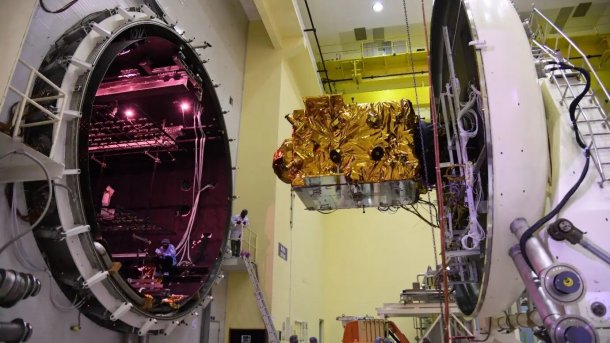
Loading of the NVS-02 satellite: alternative mission strategies
(Image: ISRO)
The 100th launch was not a success: the Indian satellite NVS-02, which was recently launched, is stuck in the wrong orbit. Its future is unclear. A Geosynchronous Satellite Launch Vehicle Mk 2 (GSLV) rocket had launched the satellite into space on January 29, 2025. It was the 100th rocket launch from the Satish Dhawan Space Center in Sriharikota in southeast India. The launch was successful, and the rocket deployed the satellite in the planned geosynchronous transfer orbit (GTO) as planned.
From there, NVS-02 was supposed to fly into a geostationary orbit using its propulsion. However, this was not possible, according to the Indian Space Research Organization (ISRO). Because the valves for supplying the oxidizer did not open, the engines could not have been ignited.
NVS-02 is intended for India's satellite navigation system
The 2.25-ton NVS-02 is the second satellite in the NVS series. This is the new generation of satellites for India's satellite navigation system, the Indian Regional Navigation Satellite System. It is available regionally, in India and around 1,500 kilometers beyond the country's borders, and has been in operation since 2016.
Videos by heise
The NVS satellites are intended to replace the first generation of satellites. NVS-01 was launched in 2023. A total of seven NVS satellites are planned.
According to ISRO, NVS-02 itself is currently in an elliptical orbit and is ready for use. The solar panels have been deployed and are supplying the satellite with power. The control center on Earth can communicate with it. The ISRO is currently “working on alternative mission strategies for using the satellite for navigation in an elliptical orbit”.



(wpl)

