


Mass layoffs announced: Boeing prepares to end SLS program
The development of the SLS rocket took too long and was too expensive. A reduced NASA budget could mean the end - and the loss of many jobs.
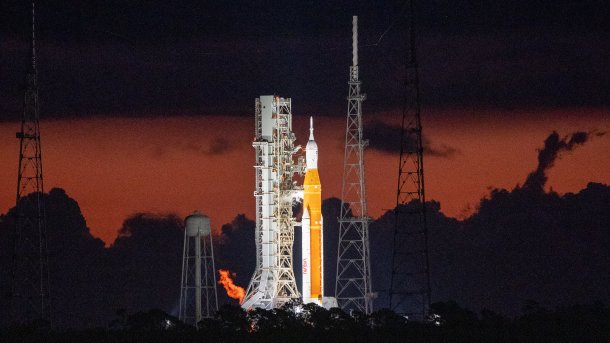
SLS heavy-lift rocket on the launch pad: Will it still fly the Artemis 2 and 3 missions?
(Image: NASA/Keegan Barber)
Boeing is likely to lose a large, long-term contract from the US space agency NASA (National Aeronautics And Space Administration). The US aerospace company will therefore be laying off a large number of employees in the coming months.
NASA is expected to award the contract to build the Space Launch System (SLS) heavy-lift rocket, announced David Dutcher, head of the SLS program, to around 800 employees working on the project. The contract with NASA could end in March, he said. In this case, Boeing will lay off half of the SLS program employees in April. This has been reported by several US media outlets, including the online magazine Ars Technica and the news agency Bloomberg.
The decision has not yet been made. However, Boeing has already informed the employees, as US law requires 60 days' notice before 100 or more jobs are cut.
NASA funding could be cut
The action is linked to the US federal budget for 2026, the first draft of which is due to be published these days. It is assumed that US President Donald Trump will cut NASA's funding.
Ars Technica reports, citing several sources, that the government and NASA leadership have been negotiating the future of the SLS and the Artemis program. Janet Petro, the acting head of the space agency, is said to have urged that the two Artemis missions planned for 2026 and 2027 should still be flown with the SLS before the program is discontinued.
SLS first flight with a delay
NASA commissioned Boeing to build the SLS in 2014. The USA wanted to use the most powerful rocket at the time to carry out missions into deep space again, for example to the moon and Mars. However, development was delayed due to technical problems. Instead of 2017 as planned, the rocket was not launched for the first time until 2022. This increased the costs immensely, which led to massive criticism.
Videos by heise
If the SLS is discontinued, NASA will have the launch vehicles of private space companies Blue Origin and SpaceX at its disposal. The latter's Falcon Heavy rocket has been in use since February 0218. The giant Starship rocket, on the other hand, is still causing problems. Blue Origin successfully premiered the New Glenn rocket in January.
The private space companies are faster at development. SpaceX rocket launches are also significantly cheaper than those of NASA, partly because reusable rocket stages are used.



(wpl)

