


Cash boost: Government supports mobile satellite launch plan in the North Sea
The Ministry of Transport approved 870,000 euros for a planned offshore spaceport. Prior, in particular, the economic department had expressed many concerns.
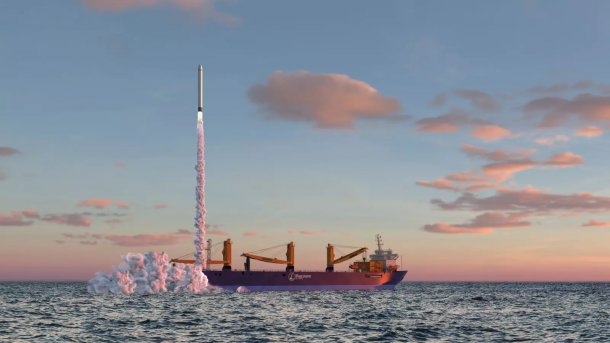
A floating launch platform for rockets could look like this (rendering).
(Image: GOSA)
The Federal Ministry for Digital and Transport Affairs (BMDV) is supporting the plan for a mobile platform in the North Sea to launch space rockets that will carry satellites into space. It is therefore funding a preliminary project to plan the floating launch platform for small launch vehicles with 870,000 euros. This will enable the German Offshore Spaceport Alliance (GOSA) to develop a “holistic” solution for the spaceport for primarily commercial orbital and suborbital launches by the end of September. BMDV State Secretary Stefan Schnorr (FDP) justified the financial injection by saying that space is “an important future market with great economic potential, also for the German economy”.
“The demand for satellites and the importance of the industry continue to grow,” emphasized Schnorr. He assumes that – the European market for satellite production will “grow by billions” in the coming years, and not just because of constellations for broadband internet such as Starlink, Kuiper or IRIS2 –. Specifically, the ministry is funding the joint project “Offshore Spaceport – Solution finding and infrastructure development for orbital launches” (OSLIOS), which is backed by GOSA. After several delays, the consortium plans to launch the first microlaunchers from the platform in the sea in 2026.
Government also has environmental impact in mind
The Bremen-based space company OHB, the engineering services provider Tractebel Engineering, the telecommunications provider MediaMobil, the shipping company Harren & Partner, the insurance company Lampe & Schwartze and BLG Logistics are involved in Gosa. The funding measure is being carried out by the German Space Agency at the German Aerospace Center (DLR) on behalf of the BMDV. The knowledge gained as part of OSLIOS is to be incorporated into the development of test systems and pave the way for the use of mobile infrastructure. Schnorr also hopes that this will contribute to “European sovereignty in this future technology”.
Videos by heise
The Federal Government and the Bundestag initially supported the project, for which the Federation of German Industries (BDI) provided the initial impetus in 2019, with a budget resolution and a volume of 2 million euros until 2025. However, the traffic light later expressed scepticism. Last year, the executive stated that launches from the North Sea would have to be carefully examined on a case-by-case basis. The environmental impact of the maritime spaceport could be extensive, warned the lead ministry for economic affairs. In addition, a space law was still missing. The advantages and disadvantages of a separate German launch site for carrier rockets were previously examined by the Office of Technology Assessment at the Bundestag.


(olb)


