


KM3NeT: European observatory detects highest-energy neutrino to date
Europe is building a huge observatory for neutrinos in the Mediterranean. Although it is not yet finished, it has already set an energy record.
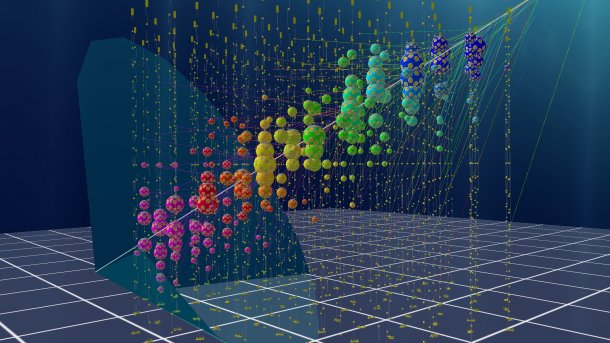
Simulated muon event in KM3NeT: The origin of the neutrino is still unknown.
(Image: KM3NeT)
Not yet officially in operation, but already measured a record: The European observatory Cubic Kilometre Neutrino Telescope (KM3NeT) has measured the most energetic neutrino ever.
The neutrino had an energy of 220 petaelectronvolts, the researchers report in the scientific journal Nature. This is more than twenty times the energy of the highest-energy neutrino to date. The discovery was made on 13 February 2023, reports the Centre national de la recherche scientifique (CNRS), the French national research organization.
Neutrinos are electrically neutral, largely massless particles. They move at almost the speed of light and rarely interact with atoms. They can, for example, pass through the earth more or less unhindered.
Scientifically, these particles are very interesting because researchers hope to gain insights into their source. Neutrinos are released during very high-energy events in space, such as stellar explosions, gamma-ray bursts or supermassive black holes at the center of a galaxy.
Neutrinos are cosmic messengers
Neutrinos are “special cosmic messengers” that provide unique information about very high-energy phenomena, explains Rosa Coniglione, deputy KM3NeT spokesperson. They make it possible to explore the furthest reaches of the universe.
Neutrinos are detected via interactions with matter. This requires huge observatories such as KM3NeT in the Mediterranean. It has two locations: ARCA off the coast of Sicily, which detected the neutrino, and ORCA off the coast of southern France. Each consists of several hundred 700-metre-long Detection Units (DU) anchored to the seabed, to each of which 18 spherical detectors (Digital Optical Modules, DOM) are attached.
When a neutrino collides with an atom, electrically charged particles known as muons are produced. When they move through the water, they produce weak, bluish flashes of light that are recorded by the detectors.
Videos by heise
According to the CNRS, the KM3-230213A event produced a single muon that passed through the entire ARCA sensor field and was detected by more than a third of the active sensors. KM3NeT is still under construction. At that time, however, only just under 10 percent of the strings were in use.
ARCA (Astroparticle Research with Cosmics in the Abyss) is located at a depth of 3500 meters and will consist of 230 DUs in the final expansion stage. ORCA (Oscillation Research with Cosmics in the Abyss) currently consists of 23 DUs at a depth of 2450 meters, each 200 meters long, and is to be expanded to 115. A third KM3Net site is planned off the west coast of Greece.
The origin of KM3-230213A is still unknown. Its high energy suggests that it did not originate from the atmosphere, but came from space. The researchers have narrowed down the area of the sky from which the particle came. However, they have not yet been able to identify its origin.



(wpl)

