


WWF searches for ghost nets with AI
Every year, many tons of fishing nets are lost at sea. The environmental protection organization WWF uses AI to detect and remove them.
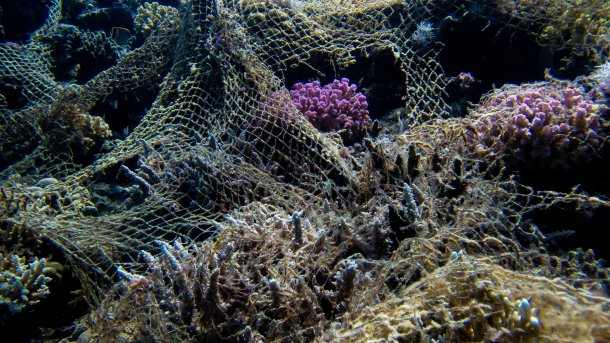
Ghost net on a coral reef: danger for marine life
(Image: Kjeld Friis/Shutterstock)
Artificial intelligence (AI) is to help keep the oceans cleaner in future: The environmental protection organization World Wide Fund For Nature (WWF) wants to use AI to track down so-called ghost nets.
Lost fishing nets, also known as ghost nets, pose a danger to all kinds of marine animals, which can become entangled in them and die as a result. Removing them from the oceans is also important because they decompose. The microplastic particles ultimately end up in the human body via the food chain.
To detect such nets, the WWF uses sonar data from the seabed, which is collected, for example, to safeguard shipping traffic or to explore locations for offshore wind turbines.
AI to evaluate sonar data
So far, humans are still evaluating this data. In future, this will be done by AI – GhostNetZero is the name of the WWF system developed by Microsoft's AI for Good Lab. The AI searches the sonar data for signatures of the nets. A human then checks the findings.
According to the WWF, the hit rate is around 90 percent. The AI is currently being trained to recognize the nets even better. Depending on the nature of the seabed, the nets have so far been difficult to distinguish from a cable.
"Ghost nets endanger marine animals and ecosystems and make up a significant proportion of plastic waste in the ocean, but they are invisible under the water surface and are difficult to locate. The combination of sonar search and AI-supported detection enables a quantum leap: "The seabed is mapped all over the world and there is a huge amount of data," said project manager Gabriele Dederer. "If we can specifically check existing image data from heavily fished marine zones, this is a real game changer for the search for ghost nets."
Videos by heise
Data to be made available to the WWF
With the support of management consultancy Accenture, the WWF has also set up the GhostNetZero.ai platform, which can be used to provide the WWF with sonar data from the seabed. The organization encourages research institutes, authorities and wind power companies to donate their data.
The WWF has so far recovered around 26 tons of nets from the Baltic Sea. However, this is only a fraction of what is found in the oceans. According to the organization, around 30 percent of plastic waste in the oceans is lost fishing gear. And large quantities are added every year: according to a study from 2022, 25 million traps and pots, 13 billion longline hooks, 740,000 kilometers of main lines and 15.5 million secondary lines as well as over 78,000 square kilometers of nets. They decompose very slowly and end up in the sea as microplastics. It is difficult to recycle them.



(wpl)

