


Microsoft calls new Majorana chip a breakthrough for quantum computing
Microsoft claims that Majorana 1 is the first quantum processor based on topological qubits. It is designed to enable extremely powerful quantum computers.
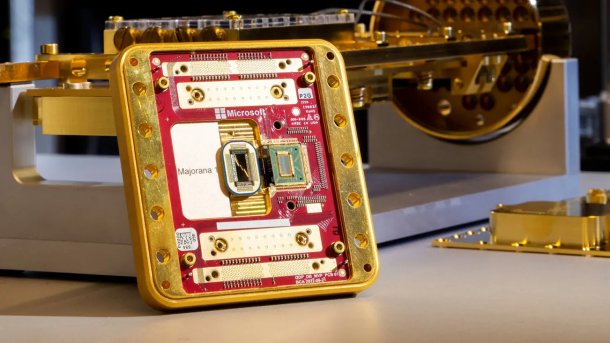
Quantum processor Majorana 1
(Image: Microsoft)
Microsoft has unveiled the Majorana 1, a new quantum processor that is set to form the basis of extremely powerful quantum computers in a few years' time. These could be used to solve scientific and medical problems that would take years to calculate using conventional computers in a much shorter time. Microsoft claims to have achieved this using new materials and a new architecture. The new chip is based on topological qubits, which represent the core of quantum computers.
Microsoft has been researching this for many years. As early as 2018, scientists from Microsoft's quantum laboratory claimed to have detected so-called Majorana states in solids for the first time. According to Microsoft's plans, the quasi-particles should enable much more robust qubits than in conventional quantum hardware. But three years later, Microsoft's quantum computing plans suffered a setback. The authors had to admit that their original data analysis was “insufficiently scientifically sound” and withdrew their results.
Videos by heise
However, Microsoft is now convinced that it has achieved a breakthrough in the development of quantum computers. One million qubits could be accommodated in a single Majorana chip, which is no larger than current server and PC processors. However, Majorana particles are used instead of electrons. The existence of such particles was postulated as early as 1937 by the Italian physicist Ettore Majorana, as they fulfill the fundamental equations of quantum mechanics. To date, however, only indications of their existence have been found – not the particles themselves.
Microsoft's topological superconductor
Microsoft now claims to have designed the world's first “topoconductor”, a topological superconductor that can create and control Majorana particles for the first time. This should enable reliable qubits. Microsoft describes the research in a Nature article. According to the article, the topological qubits use a new material made of indium arsenide and aluminum. So far, Microsoft's Majorana 1 only uses eight of these new qubits, but this should be scalable to one million qubits.
Empfohlener redaktioneller Inhalt
Mit Ihrer Zustimmung wird hier ein externes YouTube-Video (Google Ireland Limited) geladen.
Ich bin damit einverstanden, dass mir externe Inhalte angezeigt werden. Damit können personenbezogene Daten an Drittplattformen (Google Ireland Limited) übermittelt werden. Mehr dazu in unserer Datenschutzerklärung.
At the same time, Microsoft wants to significantly accelerate the development of useful quantum computers. At the beginning of this year, Nvidia boss Jensen Huang said that it would probably take another 20 years before quantum computers would become really useful. However, Microsoft now promises to be able to present a fault-tolerant prototype of its own quantum processor based on topological qubits in a few years, not decades.
Quantum experts cautiously optimistic
According to the BBC, however, experts are still cautious in their assessment of Microsoft's research and the effect on quantum computing. More data needs to be collected first. Although Microsoft could now develop prototypes more quickly, there is still a lot of work ahead of them, said Travis Humble, head of the Quantum Science Center at Oak Ridge National Laboratory in the USA. “To achieve the long-term goals of solving industrial applications on quantum computers, these prototypes need to be scaled up further,” he added.

Professor Paul Stevenson of the UK's University of Surrey is also cautious. The research presented by Microsoft is a “significant step”, but there are still tough challenges ahead. “Until the next steps are taken, it is too early to be more than cautiously optimistic,” he said. Chris Heunen, Professor of Quantum Programming at the University of Edinburgh, is more positive. He describes Microsoft's plans as “credible” and explains: “This is promising progress after more than a decade of challenges, and the next few years will show whether this exciting roadmap is working.”


(fds)

