


Unitree G1 robot puts on an exceptionally smooth dance performance
The Unitree G1 humanoid robot has received an update to its full-body movement control. It moves even more smoothly and proves this when dancing.
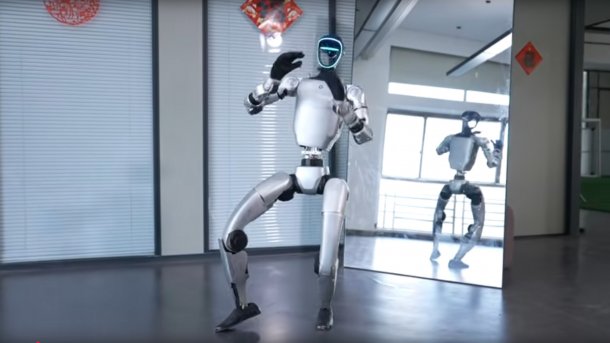
(Image: Unitree)
The Chinese robotics company Unitree has further expanded the movement capabilities of its G1 robot. In a video, the humanoid robot demonstrates its ability to perform choreographed dances and shows off its skillful leg and footwork. Many a human would wish they could dance this well.
Unitree's update for its G1 robot includes improvements in motion control. Back in January, Unitree showed a video in which the company demonstrated the robot's skillful walking and running characteristics. At the time, Unitree claimed to have developed the best walking and running system for humanoid robots. Now Unitree has gone one better and is pushing the boundaries of current motion control for humanoid robots.
Empfohlener redaktioneller Inhalt
Mit Ihrer Zustimmung wird hier ein externes YouTube-Video (Google Ireland Limited) geladen.
Ich bin damit einverstanden, dass mir externe Inhalte angezeigt werden. Damit können personenbezogene Daten an Drittplattformen (Google Ireland Limited) übermittelt werden. Mehr dazu in unserer Datenschutzerklärung.
In the video, the G1 performs a little dance. The movement transitions are exceptionally smooth. The robot's balance, previously a major problem with humanoid robots, no longer plays a role. The G1 remains stable during its performance even when it is subjected to external disturbances. The robot hardly notices any shocks and compensates for them immediately. It is still unclear when Unitree will make the motion update of the G1 robot available to its customers.
Open source full-body data set for motion optimization
Unitree has used an open-source full-body dataset to make the robot 's movements more natural and human-like. The motion data was recorded using LAFAN1 motion capture technology. It is compatible with the H1(-2) and G1 humanoid robot models so that they can perform lifelike movements. The data set also includes a “redirection algorithm” that combines interactive mesh and inverse kinematics technology. This allows movements to be optimized taking into account the end-position constraints of the robot actuators, joint positions and speed limits.
The motion dataset is open source. Unitree makes it available free of charge to interested robotics engineers so that they can use it for their projects.
Videos by heise
In addition to the G1, Unitree also has a larger, more powerful model, the H1, in its range. The H1 robot has already proven its agility several times in the past. In March 2024, for example, it set the Guinness record for the fastest humanoid robot with a top speed of 7.38 mph, approximately 11.87 km/h. It has also set a record in the standing long jump. It achieved a distance of 1.4 m.



(olb)

