


Clone Robotics shows first "full-body android"
Instead of electrical actuators, the "full-body android" Protoclone V1 uses artificial muscles that are moved by fluid pressure.
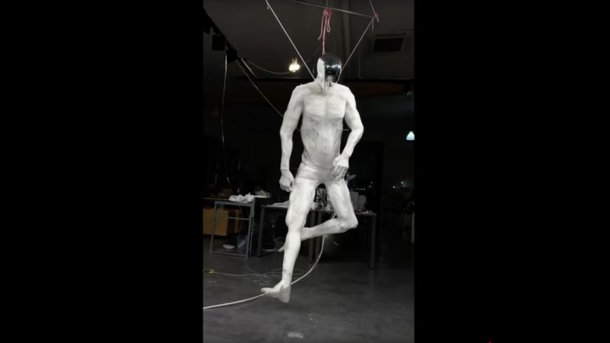
The Protoclone V1 is suspended in a frame to demonstrate its movements.
(Image: Clone Robotics (Screenshot))
The Polish start-up Clone Robotics, a specialist in biomimetic robotics, has released its first full-body android, the Protoclone V1, which is equipped with around 1000 "myofiber muscles". The entire body is said to have around 200 degrees of freedom. By comparison, current humanoid robots have around 50 degrees of freedom in their joints.
The Protoclone V1 is not intended to be a conventional humanoid robot that works with electromotive actuators. The Clone Robotics team has equipped its "full-body android" with a network of 1000 myofiber muscles that are moved by pressurized actuators. The robot's skeleton is made of 3D-printed polymer bones and is modeled on the human anatomy.
The movements are generated by myosfiber actuators. These are a network of pressurized mesh tubes that contract as soon as they are filled with a liquid and thus move the artificial muscles and tendons. Over 200 inertial and pressure sensors control the force and joint positions in real time. The fluid, which is pumped through microchannels in a frame, also ensures heat dissipation. The overall advantage of the system is that it enables smoother, more lifelike movement sequences, as the video shows.
Empfohlener redaktioneller Inhalt
Mit Ihrer Zustimmung wird hier ein externes YouTube-Video (Google Ireland Limited) geladen.
Ich bin damit einverstanden, dass mir externe Inhalte angezeigt werden. Damit können personenbezogene Daten an Drittplattformen (Google Ireland Limited) übermittelt werden. Mehr dazu in unserer Datenschutzerklärung.
The body of the Protoclone V1 is covered with a rubber skin that conceals the robot's structure. The robot does not have a face. Instead, the front of the head is adorned with a black visor. According to the developers, this is to avoid the "Uncanny Valley" effect, which can trigger a creepy effect in humans and reduce acceptance of the robot. The head also contains a large number of sensors.
Walking does not yet work
The Protoclone V1 is not yet able to walk. To demonstrate its movement capabilities, it is suspended freely in a frame. It is unclear whether the technology is even suitable for getting the robot to walk on two legs. On the one hand, the skeletal structure must be supported by very strong muscles in order to carry the entire weight. Secondly, the pneumatic system may not be fast enough to make the necessary balance corrections required for walking and running.
However, Clone Robotics seems to expect to get these problems under control quickly. An alpha edition is to be created in 2025. Clone α will probably initially only be available in a small quantity of 279 robots. Clone Robotics wants to have breathed life into its "full-body android" –, i.e. with legs –, in the form of a control system based on artificial intelligence (AI).
Videos by heise
The company's promises on the robot's pre-order website sound rather grandiose. It should be able to perform simple household tasks such as vacuuming, making sandwiches and doing the laundry right from the start. It can be taught new skills via a telekinesis training platform.
The cost of the Clone α is not yet known.



(olb)

