


GOAT robot gets through any terrain by changing shape
GOAT robot moves forward with little energy expenditure. It adapts its body to the terrain in order to move optimally.
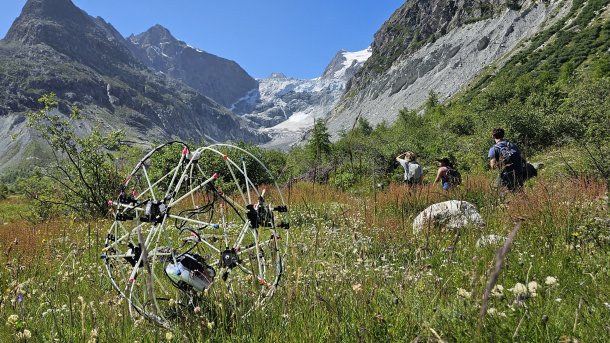
The GOAT robot can adapt its shape to the terrain. Here it rolls passively down a hill as a ball without requiring any energy.
(Image: Create Lab EPFL)
A research team from the École Polytechnique Fédérale de Lausanne (EPFL) School of Engineering has developed a robot called GOAT for Good Over All Terrains, which independently adapts its shape to different terrain formations to move faster. It requires very little energy to move.
Unlike their wheeled counterparts, robots with legs can get through any terrain. However, controlling and operating mechanical legs is very energy-intensive. Researchers at EPFL's Create Lab wanted to create a robot that requires little energy for locomotion and can still get through any terrain.
The scientists have focused their research on the shape of the robot as such, as they write in the study “Robotic locomotion through active and passive morphological adaptation in extreme outdoor environments”, which has been published in Science Robotics. The core of their considerations is that the robot should be able to automatically adapt its shape to the terrain in which it is moving. For example, it can drive, roll passively or swim.
Adaptable shape for low-energy locomotion
The robot is constructed from simple, inexpensive materials. The basic construction is a frame made of two intersecting elastic fiberglass rods. Attached to this are four motorized wheels consisting solely of spokes. The shape of the frame can be changed by winching it with ropes. For example, the robot can assume a flat shape, but it can also contract into a sphere. The control electronics, sensors, and battery are suspended in the middle of the frame. The robot can also carry a payload of up to 2 kg.
Empfohlener redaktioneller Inhalt
Mit Ihrer Zustimmung wird hier ein externes Video (TargetVideo GmbH) geladen.
Ich bin damit einverstanden, dass mir externe Inhalte angezeigt werden. Damit können personenbezogene Daten an Drittplattformen (TargetVideo GmbH) übermittelt werden. Mehr dazu in unserer Datenschutzerklärung.
The fact that GOAT's body is flexible and can change shape means that it does not need as many sensors. It only has a satellite navigation system and an inertial measurement unit (IMU) to determine its position in space. The robot does not need cameras because it does not necessarily need to know what is in its path.
“Most robots navigating extreme terrain have many sensors to determine the state of each motor, but thanks to its ability to use its compliance, GOAT doesn't need complex sensors. It can use the environment, even with very limited knowledge of it, to find the best path: the path of least resistance,” says Max Polzin, one of the EPFL scientists involved in the project.
The sensor technology is sufficient to determine the appropriate shape of the robot for the terrain using its data and algorithmic evaluation. What's more, GOAT also considers the path to be covered in addition to the mode of locomotion.
Videos by heise
“Instead of going around an obstacle such as a stream, for example, GOAT can swim straight through it. If its path is hilly, it can passively roll downhill as a ball to save time and energy, and then actively move as a rover when rolling is no longer an advantage,” explains Josie Hughes, co-author of the study.
By adapting its body to the respective terrain, the robot can select the most energy-efficient mode of locomotion.



(olb)

