


Figure AI: First tests for humanoid robots in the home before 2025
With Helix, Figure AI has taken a first step towards using its robots in unstructured environments such as households.
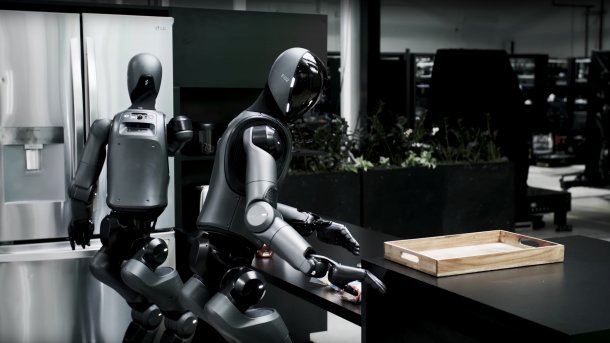
Two Figure 02 robots work together in the household.
(Image: Figure AI (Screenshot))
The robotics company Figure AI, developer and manufacturer of the humanoid robot Figure 02, intends to use its robots not only in industry, but is also looking at private households as potential customers. Brett Adcock, CEO of Figure AI, announced on X on Thursday that he intends to start carrying out alpha tests with his robots in households in 2025. The latest iteration of his humanoid robots will be used: Figure 02.
Figure AI presented its generalist vision-language-action (VLA) model Helix in a video in mid-February. The machine learning platform for humanoid robots enables robots to process visual information and voice input, i.e. to understand and implement natural language commands in real time. Figure AI demonstrated this using two Figure 02 robots, which were asked to clear away objects in a kitchen on command.
Empfohlener redaktioneller Inhalt
Mit Ihrer Zustimmung wird hier ein externes YouTube-Video (Google Ireland Limited) geladen.
Ich bin damit einverstanden, dass mir externe Inhalte angezeigt werden. Damit können personenbezogene Daten an Drittplattformen (Google Ireland Limited) übermittelt werden. Mehr dazu in unserer Datenschutzerklärung.
The objects were initially unknown to both robots. They then worked together so that items that belonged in the fridge were also put away there, while other items ended up in the appropriate kitchen drawers. Both humanoid robots worked collaboratively and exchanged objects. Helix is therefore able to orchestrate two robots in such a way that they can perform a task together.
Humanoid robots for unstructured household environments
Until now, Figure AI had largely focused on industrial applications for its humanoid robots. For example, Figure AI has its robots in use at BMW. Helix now offers Figure AI the opportunity to extend the field of application of its robots to household use and to leave the highly structured industrial environments behind. Complicated optimization of the robot is no longer necessary if the robot is equipped with Helix ex works and can therefore largely find its way around unstructured household environments independently and can also perform tasks on demand.
The competition seems to have similar ambitions: Apptronik and Tesla also want to make their humanoid robots fit for household use. However, there is not yet much to see from either company. Apparently, their development focus is initially on the supposedly more lucrative use in industry. Other manufacturers, on the other hand, are explicitly focusing on private households, such as the Norwegian robotics start-up 1X with its humanoid robot Neo Gamma. The company also refers to the robot as a "home humanoid", which is intended to act as a "personal assistant" and "companion" at home. 1X has already demonstrated its first applications.
Videos by heise
Figure AI, on the other hand, is pursuing a dual strategy and wants to use its robots in both industrial and domestic applications in the long term. The first robots should be seen in the home in two years' time at the earliest, i.e. from around 2027.



(olb)

