


Duck.ai and Assist: DuckDuckGo's AI answers leave the beta phase
In future, DuckDuckGo will offer AI-generated answers as continuous text on request. The chatbot can also use the web.
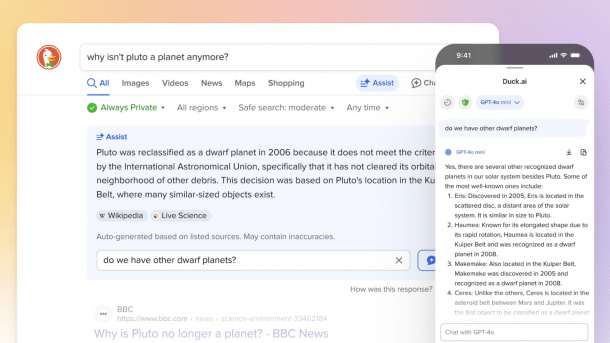
(Image: Screenshot Blogbeitrag DuckDuckGo)
DuckDuckGo gets AI-generated answers, similar to Google's AI Overviews. The web search is also to be incorporated into the Duck.ai chatbot. Both were previously only available as beta versions. During the test phase, the AI answers only used Wikipedia – as a source and now the entire web is being used.
Unlike Google's AI Overviews, DuckDuckGo's AI answers can be switched on and off – because they know that not everyone wants AI in their lives. You can also choose how often you want to receive continuous AI texts instead of lists of links. The search engine then decides for itself when it makes sense to give an AI answer and when a list of websites is better. In the blog post, DuckDuckGo writes that if you select "often", around 20 percent of the answers appear as AI-generated text. Google also decides when to display AI Overviews. There is no real off switch, but you can trigger a purely text-based web search.
Privacy protection a la DuckDuckGo
DuckDuckGo emphasizes that people's privacy remains protected as before when it comes to AI answers. No account is required to use the AI functions or the chatbot. Apparently DuckDuckGo is so convinced of the function that they say: "If you weren't satisfied with DuckDuckGo before, now is the right time to try us out again."
Videos by heise
The AI answers and Duck.ai do not have their own AI models working in the background. The provider uses GPT-4o mini and o3 mini from OpenAI, Metas Llama 3.3, Mistral Small 3 and Claude 3 Haiku from Anthropic. A new feature of the chatbot is that it remembers recent conversations – which are saved locally.
DuckDuckGo writes that they are convinced that the best way to protect personal information is not to collect it in the first place. Apparently, human input is not shared even with the AI queries. "Our AI approach extends this strategy by integrating protected AI features that provide the productivity benefits of AI without the privacy risks, such as tracking prompts and training with your data," it says. Chats are anonymized through "proxying", so IP addresses remain secret. There are also contractual assurances from the model providers.
In the coming weeks, the Duck.ai chatbot will also have a voice mode and the option to upload images and ask questions about them. This is not quite the same as the real-time image and video sharing that OpenAI and Google already have up their sleeves.


(emw)


