


Space probe: manufacturer declares Athena "dead" after tipping over on the moon
Intuitive Machines ended Athena's mission prematurely after the transportation device fell over shortly after landing near the moon's south pole.
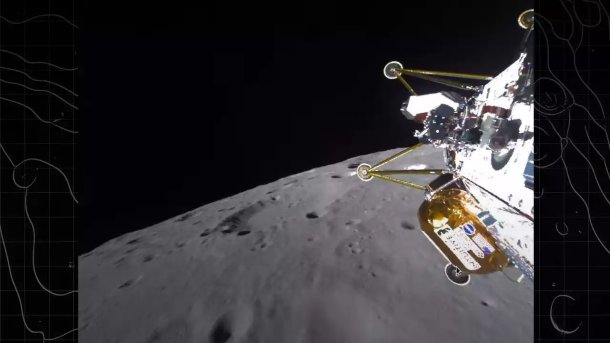
Athena shortly before touchdown.
(Image: NASA, Screenshot: heise online)
There is no longer any doubt about the premature end of the lunar lander Athena's IM-2 mission. The manufacturer Intuitive Machines announced on Friday that the space probe was no longer functional just one day after its arrival on the lunar surface. The Houston-based company was supposed to search for water at the south pole of the Earth's satellite as part of the operation commissioned by NASA. However, the service provider has now confirmed fears that Athena tipped over on landing and is lying on its side. This was confirmed by images that the transport device was still transmitting on the lunar surface.
After landing, the mission managers were able to accelerate several program components and the application of "milestones" of the transported payload "before the lander's batteries were exhausted", explained Intuitive Machines. Among them was a brief commissioning of NASA's PRIME-1 (Polar Resources Ice-Mining Experiment-1) drill. However, "given the direction of the sun, the orientation of the solar panels and the extremely cold temperatures in the crater", the company no longer expects "Athena to recharge". The mission has been "completed" and the teams are still evaluating the data collected.
According to Intuitive Machines, Athena touched down 250 meters from its intended landing site in the Mons Mouton region at the moon's south pole. "This was the southernmost lunar landing and surface operation ever conducted," the company explains. This region is characterized by a harsh sun angle and limited direct communication with Earth. It had also previously been avoided due to its rough terrain. Despite the early stop, IM-2 could "open up this region for further space exploration".
Rover MAPP and Hopper Grace are also affected
The space probe was supposed to be in operation on site for around ten days before the lunar night would fall on the mountain around 160 kilometers from the South Pole. Sensors from PRIME-1 had switched on and detected elements, but these were "likely due to gases emitted by the lander's propulsion system", NASA reports. The Colorado-based company Lunar Outpost, which contributed the four-wheeled Mobile Autonomous Prospecting Platform (MAPP) rover to the mission, regretted that it was not operational.
Videos by heise
The Grace hopper was also on board. It was to use cold gas jets to perform jumps and hop into a crater up to 25 kilometers from the landing site, where it was to measure the temperature of the rock and analyze its water content using a radiometer supplied by Germany. Intuitive Machines has not yet commented on its fate. Nokia also wanted to test 4G/LTE on the moon with a Lunar Surface Communication System.
The premature end for Athena is reminiscent of Intuitive Machines' most recent lunar mission, which brought the Odysseus lander to the same south polar region in February 2024. The probe also fell over, but was operational for around six days. However, its antennas were pointing in an unfavorable direction, which made it difficult to transfer large amounts of data to Earth. The US ferry Blue Ghost from Firefly Aerospace, on the other hand, successfully landed in Mare Crisium last week.


(nie)


