


AI ring translates sign language in real time
A ring developed by a US university could make it easier for deaf people to input data into computers. It uses AI to recognize sign language.
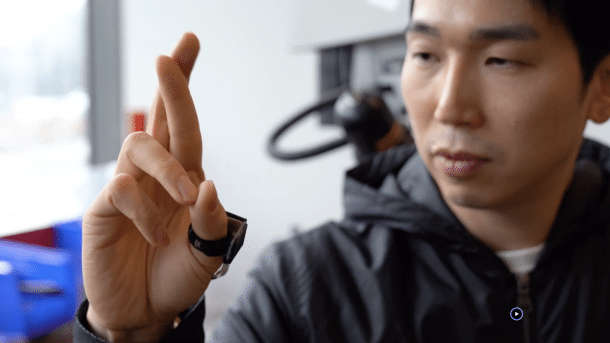
Cornell University's AI ring will enable computers to support sign language as an input method
(Image: Cornell-Universität)
An AI ring developed by Cornell University in the USA could in future provide deaf people with a mobile solution for entering data into computers and smartphones. It is to be demonstrated in action for the first time at a conference in Japan at the end of April.
Until now, there has been no shortage of methods for using American Sign Language (ASL) to input data into a computer. However, whether video solutions, glove sensors or Microsoft Kinect, all the existing technologies were more for stationary use and required a certain amount of effort before they could be used.
Ring with micro-sonar technology
The SpellRing developed by a team of researchers could mark a turning point here. The prototype, which is just the size of a two-euro piece and is worn on the thumb, is so portable that it can also be used on the move. Further development of the ring is likely to make it even more compact. Currently, it only captures the finger alphabet, i.e. a fraction of sign language.
Videos by heise
The researchers are working with micro-sonar technology to continuously track the movement of the wearer's fingers. The inaudible sound waves are emitted by a loudspeaker on the ring and picked up again by a microphone. Together with a mini-gyroscope in the ring, which records the hand movements, the artificial intelligence can literally make sense of which letter of the finger alphabet is currently being shown by the wearer.

Tested with 20,000 words
According to the researchers, the predictions are already between 82 and 92 percent accurate. This depends on the difficulty of the words. The ring, which was created in a 3D printer, was tested with over 20,000 words of different lengths and with the support of 20 experienced and inexperienced sign language users.
The ring is just the beginning. In the future, the ring will be complemented by a pair of glasses that will be used to capture upper body movements and facial expressions. According to the researchers, the glasses and ring will then be able to fully capture complex optical speech and provide users with technology that is suitable for everyday use.


(mki)

