


Mount Everest: DJI drones show Sherpas dangerous path through Khumbu icefall
Sherpa on Mount Everest is a dangerous job. They transport equipment through the dangerous Khumbu Icefall. Drones are supposed to reduce the danger.
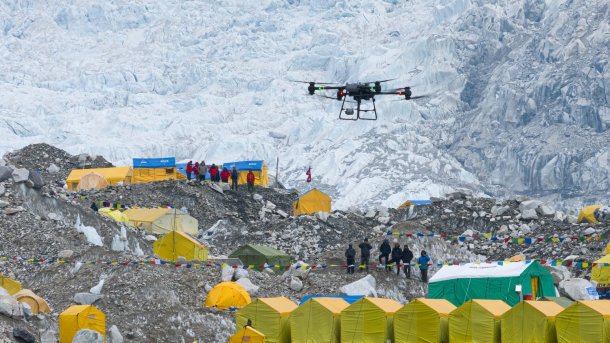
A DJI transport drone hovers over the base camp at the foot of Mount Everest.
(Image: DJI)
Sherpas on Mount Everest, the highest mountain on earth at, 8848 m, have a dangerous and tough job: they transport food and equipment through ice and snow and have to carry heavy weights up high. A particularly difficult undertaking is the crossing of the Khumbu Icefall, southwest of the Mount Everest summit, between the base camp and Camp I. Sherpas repeatedly have accidents and suffer injuries or even die in the process. To avoid such accidents, transport drones from the Chinese drone manufacturer DJI will in future show the Sherpas an accessible route.
The main climbing season on Mount Everest begins in April. DJI transport drones, which can carry up to 15 kg of equipment, will then deliver equipment such as warm clothing and oxygen bottles as well as food to the camps on the mountain. The drones will also be used to retrieve ladders for setting up routes and to carry away waste left behind by climbers. Sherpas need around seven hours to walk from base camp to Camp I, drones can do this in around 15 minutes.
At the end of April 2024, the Nepalese drone service provider Airlift, DJI, and the video production company 8KRAW, together with the certified mountain guide Mingma Gyalje Sherpa, completed the first drone delivery of two Flycart 30s to Mount Everest. Over the past year, many tests, and improvements have been carried out to ensure that the drones can withstand the extreme weather conditions on Mount Everest. They have to withstand temperatures between -15 °C and 5 °C and wind speeds of up to 15 m/s. The drones must also be able to withstand the altitude and function up to an altitude of 6000 m. The drones were subjected to hovering, wind resistance, cold weather and heavy load tests. After an extensive test phase, a kind of regular operation is now set to begin and relieve the sherpas.
Drone as a guide
However, the drones not only perform transport tasks. They are also intended to show the so-called “icefall doctors” the way. These are highly qualified Sherpas who lay ladders and ropes across crevasses before the start of the climbing season to create and secure an accessible route. They travel up to 40 times a season, heavily laden with equipment and supplies for Camp I. The DJI drones will accompany them on their way and help them find difficult passages through the Khumbu Icefall.
Until now, the Sherpas have had to find possible routes by trial and error, sometimes coming to dead ends and trying out different variants to find a viable route through seracs (towers of glacial ice) and crevasses for the tourist climbers. This also resulted in fatal accidents. In 2023, three Sherpas died in an avalanche while they were fixing ropes. This was also the trigger for improving the situation for the Sherpas. Possible routes are now being determined with the help of drone images. The drones fly ahead of the Sherpas and show them a possible, safe route.
Videos by heise
However, the use of drones also has another positive effect: expensive transport flights with helicopters then have to be carried out less frequently. This also protects the environment on the mountain, which is already under pressure.



(olb)

