


One-legged robot hops from branch to branch like a squirrel
Squirrels move nimbly by leaping through the treetops. A robot from the University of California wants to do the same.
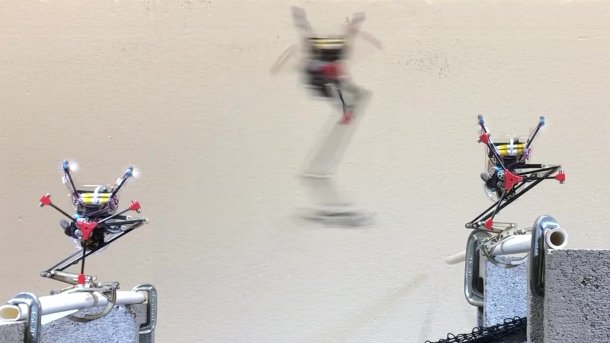
One leg is enough for the robot to jump from one pole to the next without falling down.
(Image: Justin Yim / UC Berkeley)
Squirrels are among the most popular animals because they are so cute, and probably also because they can move smoothly through the treetops. Scientists at the University of California, Berkeley (UC Berkeley) have developed a robot that can jump from branch to branch on one leg without falling down. The researchers have copied a lot from squirrels. But the one-legged robot is not cute.
The UC Berkeley research team, consisting of engineers and biologists, analyzed studies on the biodynamics of squirrels' jumps and landings to develop a robot that can jump from and land on wooden poles, wires, and beams. The researchers describe the robot in the study “Monopedal robot branch-to-branch leaping and landing inspired by squirrel balance control”, which has been published in Science Robotics.
Jumping with one leg
The scientists did not develop the robot from scratch. Instead, they used the one-legged robot Salto (Saltatorial Agile Locomotion on Terrain Obstacles), which was developed at UC Berkeley in 2016 as a high-performance hopping robot and can already stand on one leg while maintaining its position. However, this only works on level ground. The new robot, on the other hand, should be able to land precisely on thin poles and stay on them, which posed a particular challenge for the researchers. The robot jumps using a jump motor that pulls the legs together, which then abruptly release their energy for the jump. Two electric motor-driven rotors support the jump and serve to stabilize it.
Empfohlener redaktioneller Inhalt
Mit Ihrer Zustimmung wird hier ein externes Video (TargetVideo GmbH) geladen.
Ich bin damit einverstanden, dass mir externe Inhalte angezeigt werden. Damit können personenbezogene Daten an Drittplattformen (TargetVideo GmbH) übermittelt werden. Mehr dazu in unserer Datenschutzerklärung.
Salto's special ability lies in his ability to stabilize himself. To do this, he uses a flywheel, with which he can maintain his balance by rotating. However, this is not enough for a precise landing on thin poles, for example. Absorbing the kinetic energy during landing also proved to be a problem. Squirrels manage this by absorbing 86 percent of the kinetic energy on landing by standing on their front paws.
It's the landing that counts
The scientists therefore adapted the robot design to achieve a similar effect. They used the flywheel and ran it backwards during the jump to slow the robot down on landing and thus absorb some of the energy. The scientists also added a passive gripper to the leg. It is designed to prevent the foot from exerting torque on the rod. It is therefore designed to generate little friction. The flywheel and the rotors then stabilize the robot on the rod. The scientists also use adjustable legs to supplement the torque of the reaction wheel.
Videos by heise
The modified somersault robot can thus jump from one pole to another and perform larger jumps at the same time. The one-legged jump has proven to be particularly effective. However, it doesn't always work every time. Sometimes the robot does not hit the pole accurately enough, or it cannot absorb enough energy when it lands. So the scientists still have some work to do.



(olb)

