


WTF: AI upscaling turns 80s sitcom on Netflix into a scary show
The series "College Fever" has recently been available to watch on Netflix in Germany. An AI really let off steam during 4K upscaling.
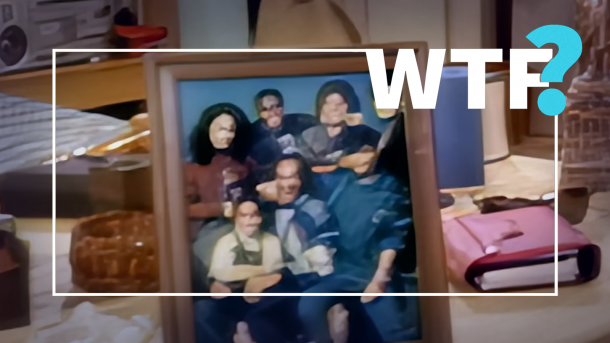
This is how Netflix's AI imagines the Huxtable family. Only in this screenshot have we increased the contrast; the original looks even darker.
(Image: Netflix, Screenshot und Bearbeitung: heise online)
In media editing, upscaling images and videos using artificial intelligence is one of the most useful functions – if the AI "knows" to some extent what content it is dealing with. This was obviously not the case when editing the sitcom "A Different World", which was originally released in the USA in 1987.
Numerous viewers and a number of US media outlets have been making fun of the results for weeks. In fact, the AI here produced some of the typical artifacts and hallucinations that first-generation models caused a few years ago. In the case of "College Fever", however, a number of effects from earlier analog and digital edits are apparently also improved, more on that in a moment.

Everyone squints, some wave their teeth
In the current version of the series, as it can currently be seen on Netflix in Germany, there is something in every scene that is simply not right, even on a cursory viewing. Depending on their movements and expressions, all the characters seem to squint from time to time and, particularly creepily, the teeth move and are sometimes particularly regular, and sometimes incompletely present. Or they merge into single, large chewing tools. Writing on posters, doors, clothing or sofa cushions is illegible and, if decipherable, can be seen in strangely fused letters. Objects disappear behind things that are actually in the foreground, and on some surfaces that are actually pure white, there are strange spots of color that change from image to image.

(Image: Netflix, Screenshot: heise online)
Videos by heise
Netflix or the companies involved have yet to comment on this "melted nightmare", according to Vice. This WTF message is therefore followed by a speculation by the author based on a little experience in analog and digital media editing and the history of the series itself. Incidentally, it started out as a spin-off of "The Cosby Show" and was supposed to follow the character of Denise Huxtable on her way through college. When the actress playing Denise, Lisa Bonet, left the series after the first season, the previous supporting roles took over the narrative. The series transitioned from a typical college sitcom to more serious tones of the late 1980s and early 1990s, such as dealing with HIV/AIDS, and was often praised, especially in retrospect.

(Image: Netflix, Screenshot: heise online)
From film to magnetic tape to AI
So much for the facts, now it gets a little speculative. A Different World" was shot on analog film, as was common practice during its production period from 1987 to 1993. And it was just as common at the time for an analog master to be created for the DVDs –, of which only the first season was released in 2005 –. Digital film scanning was new at the time and still very expensive, and even today many studios shy away from the expense. The DVD master was presumably a magnetic tape.

(Image: Netflix, Screenshot: heise online)
Later broadcasts, even on digital television, showed the typical color fringing caused by barely processed analog transfers, such as dot crawl, which is caused by crosstalk effects. The old principle of digitization applies to these analogue artefacts:"Garbage in, garbage out". Or, as sometimes used: "Garbage in, garbage out2", because: Digitization tends to amplify analog errors quadratically.
Garbage to the power of four
This probably also explains the color errors that appear in "College Fever", for example in black lettering on white clothing: The color fringing was already there before, the AI has now guessed incorrectly what should be colorful and what should be white. In the case of poorly digitized material, one could extend the mnemonic when an AI is unleashed on it: "Garbage in, garbage out4". However, this only explains the obvious technical errors in the image, not the content.

(Image: Netflix, Screenshot: heise online)
These could be due to the fact that the AI used here has not been trained with the series or with corresponding television content at all. If you look at the portrait of the Huxtable family in the first episode from minute 14:22 onwards, which Denise has placed clearly visible in her student digs, it is striking: The AI can never have seen these faces before. The depiction looks as if Salvador Dali had painted a paint-by-numbers template by Picasso from his Cubist period. In a very drunk state.
Embarrassing for Netflix
For a global media company like Netflix, this is more than embarrassing. Obviously, no one really looked at the result of this AI mess before it was released. If they had, they would have noticed that what you would normally expect from a digital restoration was not even remotely fulfilled: the contrasts are generally dull, as with poor magnetic tape transfers, while pure colors such as red or white in particular appear overexposed. We saw this on a calibrated IPS monitor for image processing as well as on a mid-range 4K TV with a VA display and an OLED smartphone. All image noise – always present in film – has disappeared, everything looks smooth, and the soap effect is omnipresent, presumably due to poor intermediate image calculation.

(Image: Netflix, Screenshot: heise online)
And this, together with the creepy AI images, runs through the entire series, as we checked with random samples across the six seasons. It seems as if this AI wasn't even allowed to learn from its own work. Finally, it should be noted that this is not a case of disappointed love on the part of the author, who was only marginally aware of the series in the 1990s. Rather, this version of "A Different World" is simply a particularly good example of how not to do this.


(nie)


