


AMD rumors: Before notebook CPUs with Zen 6 comes a Zen 5 refresh
According to a roadmap leak, AMD will first refresh its Ryzen AI 300 with Gorgon Point before new CPU cores arrive in notebooks with Medusa Point.
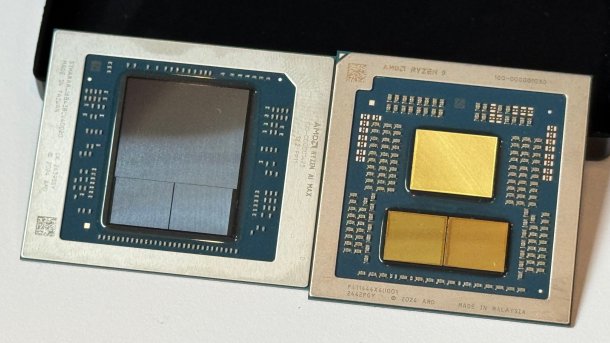
AMD currently only uses chiplets in its notebook processors for powerful specials: Strix Halo on the left with a thick integrated graphics unit in the SoC chiplet and the desktop offshoot Fire Range on the right.
(Image: c't / mue)
At a Korean information event, which was also about new Gram notebooks from LG, AMD gave insights into its roadmap and revealed a previously unknown code name: Gorgon Point. The slides, which are no longer available on the Korean website JNtechreview, reveal that this is a refresh, i.e. just a slightly optimized version of Strix Point aka Ryzen AI 300: There is a little more performance thanks to a clock speed increase, but still up to twelve Zen 5(c) cores and an RDNA 3.5 graphics unit.
AMD has already taken a similar approach in the past: Phoenix was marketed as Ryzen 7040 and replaced by Hawk Point aka Ryzen 8040. The next big leap was Strix Point, which also brought with it the new Ryzen AI 300 naming scheme. Since Gorgon Point is expected to last well into 2026 according to the presentation slides, we assume that AMD's marketing machinery will then run the CPUs as Ryzen AI 400. Some Gorgons are said to have an AI unit (Neural Processing Unit, NPU) that can perform over 55 tops instead of 50 trillion operations per second (50 tops). But something similar already exists in Strix Point, namely in the Ryzen AI 9 HX 375.
Before Gorgon Point, AMD still has to launch the Strix Point offshoot Krackan Point, which was unveiled at the beginning of January but is not yet available to buy. It complements Ryzen AI 300 with smaller expansion stages with only eight and six CPU cores. This is important so that notebook manufacturers have more leeway when equipping their devices and can also sell the expensive developments in more affordable entry-level configurations, depending on the market.
So far, this task has been the responsibility of Hawk Point, but these are completely different devices that are not suitable for Microsoft's Copilot+ marketing campaign. Hawk Point will still be around in 2026, but will be increasingly displaced: Gorgon Point is suitable for Copilot+ across the board and covers a range from twelve down to just four CPU cores.
Videos by heise
Next stop: Medusa
The next big technical step has been circulating in the rumor mill for some time as Medusa Point and has also been referred to as Ryzen AI 400. With Gorgon Point as a plug-in, the latter is almost certainly obsolete and Ryzen AI 500 should be more appropriate – unless AMD changes the naming scheme again because a new hype emerges by then, which should be reflected in the product name.
As Medusa Point is not due until 2026 (and probably not right at the start of the year), many of the details should still be treated with caution. Up to twelve CPU cores still sounds plausible, as the obligatory performance boost is to come from the new Zen 6 core architecture. Whether all twelve cores will really be in a single cluster instead of two remains to be seen – AMD itself has not yet revealed any details about Zen 6.
We also think it is plausible that AMD will use chiplets for Medusa Point, as the rumor mongers speculate. This would be a novelty for AMD's notebook chips for the mass market, where – unlike Intel since Core Ultra 100 (Meteor Lake), – only monolithic processors have ever been used. Similar to Strix Halo, the CPU cores should have their own chiplet that docks onto a large die with all other SoC components. With this approach, AMD could use the same CPU chiplet in both notebook and desktop processors, which would save development costs.
Further details on the SoC chiplet are not known. The biggest question mark certainly concerns the integrated graphics unit: It could be assumed that the RDNA4 GPU architecture, which recently debuted as the Radeon RX 9070 (XT) desktop graphics card, will be used, but it is not certain. Another RDNA 3.5 as with Strix/Gorgon Point would be disappointing, but according to rumors it is also conceivable. Or will there perhaps be a revised offshoot that, like RDNA 3.5, is specifically intended for graphics units integrated in processors –, so perhaps something like RDNA 4.5?
Something with a 4 in the RDNA version number would be desirable, not least because there should also be a more powerful offshoot: Just as Strix Point (Ryzen AI 300) was joined by the more powerful Strix Halo (Ryzen AI 300 Max), there should also be Medusa Halo again alongside Medusa Point. With a revised GPU architecture and two CPU chiplets with twelve cores each (i.e. 24 cores in total), the structure would not have to change significantly in order to still deliver a decent increase in performance. However, this is clearly wishful thinking at the moment.


Sound wave
Finally, there is the codename Sound Wave, which has been floating around the rumor mill for some time. It is said to belong to a chip that does not contain x86 cores but, surprisingly, ones with an ARM instruction set. According to the latest rumors, Sound Wave is not a high-performance chip, but one that will replace the low-cost offshoot Ryzen 7020 aka Mendocino (no, not Michael Holm's 70s earworm). As a reminder, this is a chip with four Zen 2 cores that AMD has been selling unchanged since 2022 for particularly inexpensive notebooks.
In this segment, the priority is not performance but the lowest possible costs. A combination of two P cores with four E cores from ARM's standard range, as recently postulated by the leaker Moore's Law is Dead for Sound Wave, could be enough. From AMD's point of view, such a processor would also solve the dilemma that, unlike Intel, it does not have its own "cheap" E-cores with x86 architecture, but would like to have them. AMD would thus be attacking Qualcomm's Snapdragon X from below as well as fueling Windows on ARM itself.
We wouldn't be surprised to see more ARM arrows in AMD's development quiver in order to be prepared for all eventualities surrounding the rise of Windows on ARM. There should be something at least as semi-custom contract work – and the customer should be Microsoft. Since mid-2024, however, this project, to which the name Sound Wave was once attributed, has been quiet – which can mean everything or nothing at the same time.
Empfohlener redaktioneller Inhalt
Mit Ihrer Zustimmung wird hier ein externer Preisvergleich (heise Preisvergleich) geladen.
Ich bin damit einverstanden, dass mir externe Inhalte angezeigt werden. Damit können personenbezogene Daten an Drittplattformen (heise Preisvergleich) übermittelt werden. Mehr dazu in unserer Datenschutzerklärung.
(mue)


