


Agility Robotics increases the safety of its humanoid robot Digit
Agility Robotics wants to increase the safety of its humanoid digit robots so that they can work more safely with people in industrial environments.
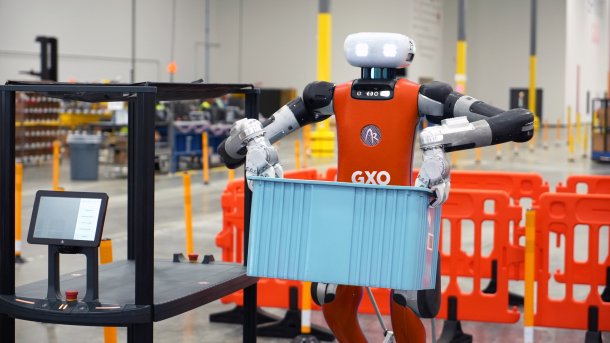
(Image: Agility Robotics)
The safety of humanoid robots working alongside humans in factories is important so as not to endanger human workers. Agility Robotics is now addressing this issue and wants to make its Digit humanoid robot safer when interacting with people so that it can work collaboratively with them.
There are already defined safety standards for stationary robots and machines that must be met to avoid injuring people in an industrial environment. Such safety standards do not yet exist for dynamically stable mobile industrial robots, such as humanoids. They should then at least meet the standards for stationary and simply mobile robots. Agility Robotics, like the US robotics company Figure AI, is now working on its standards for humanoid, collaborative robots.
Safety features
Agility Robotics has already implemented some safety features in the current version of the humanoid Digit robot. For example, Digit now has an emergency stop switch that immediately stops all robot movements in an emergency. This is intended to prevent accidents in the event of malfunctions and increase the safety of people and other machines. Part of this safety feature is a category 1 stop. When the emergency stop switch is pressed, the power supply to the robot's actuators is maintained until the robot can stop gently and safely without falling over.
FailSave over EtherCAT (FSoE) is a safety protocol designed to guarantee safe communication with a robot in industrial automation via an EtherCAT network. It allows the transmission of safety-relevant information, such as emergency stop signals and sensor feedback, while maintaining real-time performance. The protocol is now integrated into Digit.
Videos by heise
The robot controller has also been upgraded. A programmable logic safety controller (PLC) includes safety functions that correspond to performance level d (PLd). The performance level is a value that describes the ability of safety-related parts of a controller to perform a safety function under foreseeable conditions. PLd defines the probability of a dangerous failure per hour between 0.00001 and 0.0001 percent. There are a total of five performance levels from a to e. E is the best level with the lowest probability of failure.
Agility Robotics intends to further increase the safety of its Digit robots. The aim is to meet existing and self-defined safety standards in the future.



(olb)

