


This code is our code: Farewell to Bufferbloat conqueror Dave Täht
Dave Täht was committed to open source software and the right to repair. He died at the age of 59.
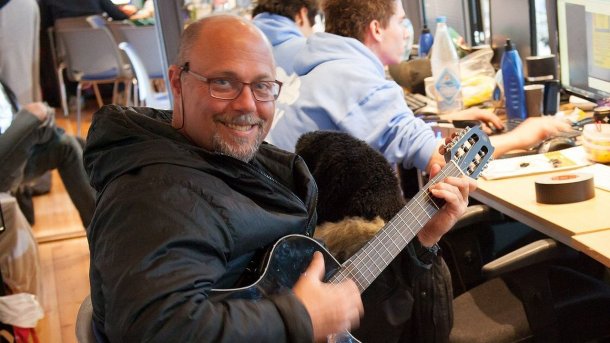
Dave Star (1965 - 2925)
(Image: Libreqos.io)
In the early 90s, he founded one of the first Linux-only Internet service providers. He fought for the right to repair until the very end. He became known to a wider professional audience primarily through his work against the problem of buffer bloat, as he called it, which was caused by the industry itself. Dave Täht died on April 1 at the age of just 59.
The queue of mourners on mailing lists across the Internet quickly swelled to a stream after the LibreQoS team published the news of the unexpected death of the US developer and Internet activist on Tuesday.
Täht had almost single-handedly embarked on the Bufferbloat project a decade and a half ago, after struggling with huge latency times during one of his many missions to realize the open Internet for all in Nicaragua. Täht recognized the problem at a time when, despite massive problems, nobody really seemed to care, said co-Bufferbloat activist Jim Gettys in his farewell email.
Architect of the Bufferbloat project
Instead of throwing more and more bandwidth at connection problems, as is customary in Western latitudes, we just need to build better routers, preached Täht. Better software, which ensures that packets are processed fairly, is far superior to the concept of constantly adding new buffers in the hardware for traffic control. Full buffers lead to unnecessary latency.
As part of the Bufferbloat project, Täht worked on the development of several algorithms, FQ-CoDel, CAKE and most recently LibreQoS, which is optimized for the management of ISP networks, as well as on router operating systems such as OpenWRT and CeroWRT.
Täht was most recently involved in the small LibreQoS team as CTO. Lucrative job offers have never been able to lure Täht, who isolated himself on his boat during the Corona period, in a development career spanning 40 years.
The latest beneficiaries of better queue management include big names such as Elon Musk's Starlink. Starlink's fancy wifi routers have been able to achieve delays of up to 7 seconds at slightly greater distances from the terminal. To get Elon Musk's attention, the nerd made quick use of one of the Internet fathers, Vint Cerf.
Videos by heise
Open routers
A few years ago, Täht also used the politically well-connected Cerf for high-profile campaigns for the good of the Internet. Together with 270 well-known developers and internet experts, he warned the FCC in 2015 against a license requirement for updates to standard routers. This would have made it extremely difficult for third parties to retrofit and secure commercial routers.
The successful campaign prompted him to campaign to the FCC again in 2023, arguing that higher bandwidths in the expansion of US networks alone do not make the network any better for end users. Rather, the problem is the careless handling of many network operators with the home routers that are delivered and then never updated.

Right to repair
Täht vehemently defended the "right to repair" until the very end. "I could make this router better if only they would let me access the device," he once said in an interview in relation to Starlink routers.
Unfortunately, many manufacturers have forgotten that the Internet has grown because manufacturers, network operators and developers have cooperated. Many use open source, but are not prepared to open up their applications and hardware in turn. However, code is like the land in Woodie Guthrie's famous song: "This code is for you and me", said Täht, who himself is always active as a filk singer.
Today, the Internet and, above all, the open source community mourns the loss of a "giant" who made the Internet better for so many without them ever having heard of him.


(Monika Ermert)

